


This is the absolute fastest way to make French press iced coffee. Just forget about cold brew concentrate – with this Quick French Press Iced Coffee Recipe you can have your iced coffee ready in 5 – 6 minutes. Who doesn’t like the French press?! It’s...
Know Your Ingredients: Rambutan
Know Your Ingredients: Rambutan
Know Your Ingredients: Rambutan
Know Your Ingredients: Rambutan
Know Your Ingredients: Rambutan
Know Your Ingredients: Rambutan
I Tested Keurig K Compact – Here’s Everything You Need To Know
The most affordable Keurig coffee maker is available exclusively at Walmart and comes at a sweet price of only $59.00. In this article, you’ll find out how good it really is, and also find additional information like how to clean it, or do you need a water...
Here’s How to Change Keurig 2.0 Water Filter Easily
Not sure how to change Keurig 2.0 water filter? Here are step-by-step instructions that will help you do it quickly and easily. Keurig water filter should be changed every 2 months or 60 tank refills. The water filter is located inside the water tank, on the valve at...
The coffee rose for assessing Anaerobic coffee
I just came across this really neat tool to assess anaerobic coffees. I haven't used it for cupping yet. I'm not sure I will like it either because the idea of lowering the score of the coffee just because it tastes has some thyme flavors. At the same time I...
Three US Coffee Championship Events Are Heading To Rancho Cucamonga
This article is from the coffee website Sprudge at http://sprudge.com. This is the RSS feed version. The 2024 US Barista Championship, Brewers Cup, and Cup Tasters will take place March 15-17 at Klatch Coffee Roasters in Rancho Cucamonga, California.
The Origin Story of Turtle Island Coffee in Vancouver, B.C.
A new Indigenous-owned coffee company based in Vancouver, British Columbia, called Turtle Island Coffee has launched with the goal of exposing more people to high quality specialty coffee and Indigenous...
Get Ready for The Barista League’s 2024 Season
The Barista League has announced 12 competitions across four continents. BY J. MARIE CARLANBARISTA MAGAZINE ONLINE Photos courtesy of The Barista League When The Barista…
Get Ready for The Barista League’s 2024 Season
The Barista League has announced 12 competitions across four continents. BY J. MARIE CARLANBARISTA MAGAZINE ONLINE Photos courtesy of The Barista League When The Barista…
Get Ready for The Barista League’s 2024 Season
The Barista League has announced 12 competitions across four continents. BY J. MARIE CARLANBARISTA MAGAZINE ONLINE Photos courtesy of The Barista League When The Barista League announces new events, it’s worth paying attention! This year, the schedule will be...
Weekly Coffee News: EUDR and Africa + More Celebrity Coffee
Welcome to DCN’s Weekly Coffee News. Keep up with all the latest coffee industry stories and career opportunities by subscribing to DCN’s newsletter. Tell our editors about your news here. Report: Small-Scale Farmers in...
Do Higher Coffee Prices Mean More Money For Farmers? A Story From Sumatra Shows It’s Complicated
This article is from the coffee website Sprudge at http://sprudge.com. This is the RSS feed version. Since coffee costs more now than ever, do those coffee prices impact the amount of money earned by coffee farmers?
Coffee News Recap, 2 Feb: Applications open for Australia’s Richest Barista 2024, De’Longhi reports 4.6% revenue increase after La Marzocco move & other stories
Every Friday, Perfect Daily Grind rounds up the top coffee industry news from the previous week. Here are this week’s coffee news stories. The word of the week is: expansion. Mon, 29 Jan AeroPress launches limited-edition Clear Pink brewer. The coffee brewer is made...
Watch The 8 Best Coffee Videos Vying For Sprudgie Awards
This article is from the coffee website Sprudge at http://sprudge.com. This is the RSS feed version. The best coffee videos from 2023 featuring Cafe Imports, Aramse, Nguyen Coffee Supply, Wildly, Mirror Coffee Roasters, Alto Stories, Quek Shio, and Cafe Retiro.
Robusta is great and has untapped potential
I live in the US and my typical choice of coffee is lightly roasted Ethiopian pour overs. I generally love acidity and fruit flavors in my coffee. My experience with Robusta has often been poor. Very dark, roasty and maybe chocolatey. I participated in the Hoffman...
Design Details: Brewing Reinvented at ULA Café in Melbourne
Welcome to Design Details, an ongoing editorial feature in Daily Coffee News focused on individual examples of coffee shop architecture, interior design, packaging design or branding. If you are a coffee...
Robert Downey Jr.’s New “Happy Coffee” Is Really Depressing
This article is from the coffee website Sprudge at http://sprudge.com. This is the RSS feed version. Robert Downey Jr. and Craig Dubitsky team up for Happy Coffee.
Out Now: The February + March 2024 Issue of Barista Magazine!
In our new issue we feature Lisa Lawson from Glasgow, Scotland, take a look at the newest grinders, explore spring drink inspiration, see how more women are getting involved in coffee tech, and much more! BY SARAH ALLENBARISTA MAGAZINE We’re stoked to announce the...
The coffee industry’s biggest competition: The story of the World Barista Championship
Every year, the global coffee industry gears up for one of its most exciting and groundbreaking competitions: the World Barista Championship. For more than two decades, the WBC has been one of the biggest catalysts for change and innovation in specialty coffee, and...
The 2023 Specialty Coffee Transaction Guide Has Landed
The 2023 edition of the Specialty Coffee Transaction Guide (SCTG) guide went live today, providing actors throughout the coffee chain a data-driven tool for green coffee price discovery. The full...
Espro great until I needed replacement filter ☹️
I've had an Espro P7 for nearly four years after seeing glowing praise on this sub (to which I later contributed). Before I bought the P7 I looked at the replacement parts available and they seemed like a solid company in that they sold e.g. replacement filters...
New Bill Requires More Kona In Your Kona Coffee
This article is from the coffee website Sprudge at http://sprudge.com. This is the RSS feed version. Currently a coffee only need to be 10% Kona to be labeled as such.
What’s the best and worst part about owning and running a coffee shop?
I'm not interested in getting into it myself, as I have no experience in the service industry, no real appetite for risk and no desire to run a business in general. But sometimes I think about it and I wonder what's the most enjoyable thing about it and...
minimum dose size?
I use the Hario switch to brew my coffee and am trying to reduce my caffeine consumption. Hence I would like to brew smaller cups of coffee. I am currently using 10g of coffee with 160g of water. (1:16 Ratio) I am wondering if there is a minimum amount of coffee...
[CAFE OWNERS] Background before starting a shop?
I’ve worked in coffee for 6 yrs as a barista and shift supervisor and have passion for it. I’ve decided that I want to open my own place in the future and so I’ve been doing the research to make a business plan. Lately, however, I’ve begun to realize just how many...
Know Your Ingredients: Rambutan
Today we explore the unique fruit rambutan, including its mythology and how you can incorporate it into café beverages.
BY EMILY MENESES
SENIOR ONLINE CONTRIBUTOR
Feature photo by Joyce Romero via Unsplash
As someone raised by two immigrants from the Philippines, I grew up in a household where ‘unusual’ fruits were a commonplace occurrence. However, I know that there are many ingredients from my childhood that may be foreign to others, which is why I’m sharing my love and fascination for these flavors through our series ”Know Your Ingredients.”
In today’s installment, we’re continuing our exploration of Asian—specifically Southeast Asian—flavors by turning our attention to rambutan. Rambutan is a tropical fruit with origins mainly in Malaysia and Indonesia. This fruit is also commonly grown in Thailand, Singapore, the Philippines, Sri Lanka, Australia, and Hawaii. Its name comes from the Malaysian rambut, meaning “hair”—a reference to the hair-like spikes on its exterior.
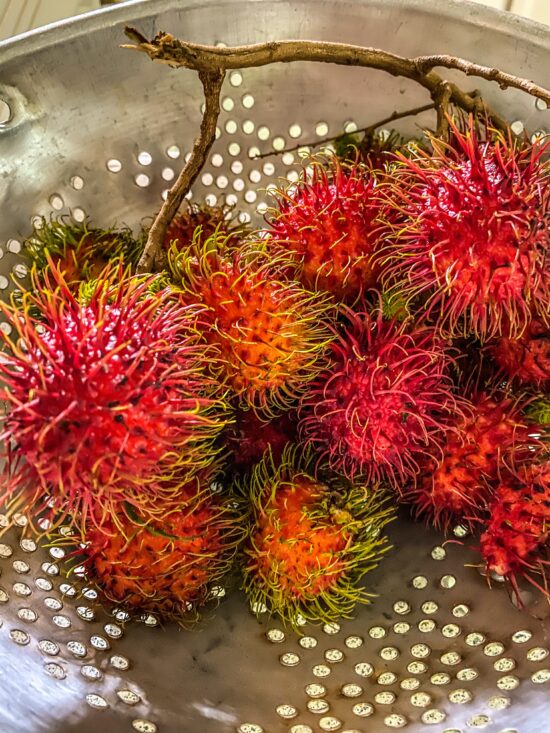
The Legend of Rambutan
An ancient Philippine legend tells the story of how rambutan came to be. One day, a man living in the forests by Rabba Mountain came across a deer being attacked by a tiger. Feeling sympathy for the deer, the man used an ax to wound the tiger, thus saving the deer’s life.
After being rescued, the deer transformed, revealing itself to be a beautiful fairy named Rodona. Rodona revealed that the tiger trying to take her life was actually Matesa, an evil witch who wished to have complete control over the forest. Grateful to the man for saving her life, Rodona promised to grant him one wish—and so he wished for a child.
The man and his wife soon had a healthy baby girl and named her Rabona, a combination of the name of Rabba Mountain and the fairy Rodona. One day, the young girl Rabona found a cat in the woods and took it home with her. At the stroke of midnight, the cat transformed into its true identity: Matesa, the witch who had tried to kill the fairy Rodona but was wounded by the man.
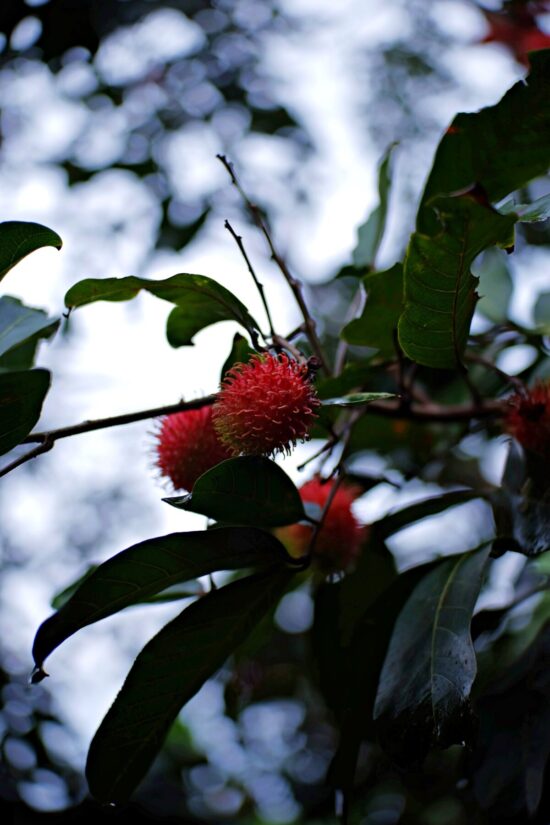
As payback for the man wounding her, Matesa placed a curse on the young girl Rabona. The curse caused the girl’s hair to grow thick, long, and cumbersome, getting in the way of her ability to do anything. Months passed, and one day, Rabona—tired of being weighed down by her hair—woke up in the middle of the night to burn down her parents’ hut.
The next morning, the parents woke to the hut burned to the ground—and Rabona was nowhere to be found. In her place, a tree had grown, adorned with peculiar fruits with long, thick, spiny “hair” growing from their skin. When the parents tasted the fruit, it was sweet—and they immediately knew that it was Rabona. To honor their lost daughter, they named the fruit rambutan, and it would eventually become known as one of the sweetest fruits the region had ever produced.
Rambutan Around the World
Rambutan’s flesh has a texture similar to a grape, with a sweet and slightly tart flavor. It’s popularly used throughout Asia in juices, ice cream, smoothies, and other desserts. Rambutan can also commonly be seen in savory dishes like salad, soup, and curry. Today, rambutan is known globally as a superfruit—rich in fiber, vitamin C, vitamin A, calcium, iron, potassium, magnesium, and more.
Rambutan in Café Drinks
Rambutan can be incorporated into beverages the way that any other fruit would. Curious to try this fruit for yourself? Try our iced rambutan matcha latte recipe below!
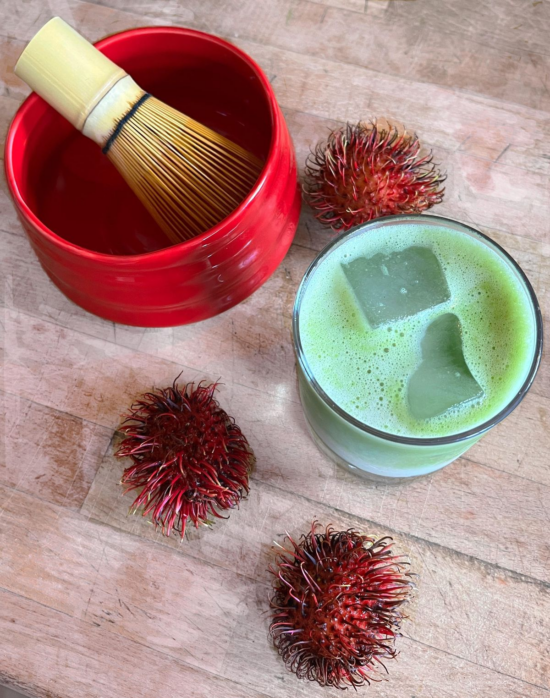
Iced Rambutan Matcha Latte
Ingredients:
Rambutan syrup:
1 cup cane sugar
1 cup water
9-10 rambutan fruits, peeled and roughly chopped
Matcha latte:
1 teaspoon matcha powder
2 oz. hot water
8 oz. milk
First, make your rambutan syrup. To do so, whisk the sugar and 1 cup of water together in a small saucepan over medium heat. Boil the combination for 5 minutes. Remove the pan from the heat, then add your chopped rambutan and mash everything together with a potato masher or a fork. Cover the saucepan with a lid and allow everything to steep for 30 minutes.
After 30 minutes, strain the mixture into a bowl or a jar. You can also add some of the crushed fruit to the syrup for texture if you’d like. Now you have your rambutan syrup, which you can add to beverages as you please! You can store the syrup in the refrigerator safely for up to a week.
Next, make your matcha latte by whisking your matcha powder with the 2 ounces of hot water. Add this mixture to your 8 ounces of milk (alternative milk is fine). Add 2 ounces of your homemade rambutan syrup and stir.
Pour the combination over ice, and it’s ready to serve!
ABOUT THE AUTHOR
Based in Los Angeles, Emily Meneses (she/her) is a writer and musician passionate about culture and collective care. You can regularly find her at Echo Park Lake, drinking a cortado and journaling about astrology, art, Animal Crossing, and her dreams.
The post Know Your Ingredients: Rambutan appeared first on Barista Magazine Online.