





This is the absolute fastest way to make French press iced coffee. Just forget about cold brew concentrate – with this Quick French Press Iced Coffee Recipe you can have your iced coffee ready in 5 – 6 minutes. Who doesn’t like the French press?! It’s...
Fines: Fine for Espresso, Not So Fine For Filter
Fines: Fine for Espresso, Not So Fine For Filter
Fines: Fine for Espresso, Not So Fine For Filter
Fines: Fine for Espresso, Not So Fine For Filter
Fines: Fine for Espresso, Not So Fine For Filter
Fines: Fine for Espresso, Not So Fine For Filter
I Tested Keurig K Compact – Here’s Everything You Need To Know
The most affordable Keurig coffee maker is available exclusively at Walmart and comes at a sweet price of only $59.00. In this article, you’ll find out how good it really is, and also find additional information like how to clean it, or do you need a water...
Here’s How to Change Keurig 2.0 Water Filter Easily
Not sure how to change Keurig 2.0 water filter? Here are step-by-step instructions that will help you do it quickly and easily. Keurig water filter should be changed every 2 months or 60 tank refills. The water filter is located inside the water tank, on the valve at...
The coffee rose for assessing Anaerobic coffee
I just came across this really neat tool to assess anaerobic coffees. I haven't used it for cupping yet. I'm not sure I will like it either because the idea of lowering the score of the coffee just because it tastes has some thyme flavors. At the same time I...
Three US Coffee Championship Events Are Heading To Rancho Cucamonga
This article is from the coffee website Sprudge at http://sprudge.com. This is the RSS feed version. The 2024 US Barista Championship, Brewers Cup, and Cup Tasters will take place March 15-17 at Klatch Coffee Roasters in Rancho Cucamonga, California.
The Origin Story of Turtle Island Coffee in Vancouver, B.C.
A new Indigenous-owned coffee company based in Vancouver, British Columbia, called Turtle Island Coffee has launched with the goal of exposing more people to high quality specialty coffee and Indigenous...
Get Ready for The Barista League’s 2024 Season
The Barista League has announced 12 competitions across four continents. BY J. MARIE CARLANBARISTA MAGAZINE ONLINE Photos courtesy of The Barista League When The Barista…
Get Ready for The Barista League’s 2024 Season
The Barista League has announced 12 competitions across four continents. BY J. MARIE CARLANBARISTA MAGAZINE ONLINE Photos courtesy of The Barista League When The Barista…
Get Ready for The Barista League’s 2024 Season
The Barista League has announced 12 competitions across four continents. BY J. MARIE CARLANBARISTA MAGAZINE ONLINE Photos courtesy of The Barista League When The Barista League announces new events, it’s worth paying attention! This year, the schedule will be...
Weekly Coffee News: EUDR and Africa + More Celebrity Coffee
Welcome to DCN’s Weekly Coffee News. Keep up with all the latest coffee industry stories and career opportunities by subscribing to DCN’s newsletter. Tell our editors about your news here. Report: Small-Scale Farmers in...
Do Higher Coffee Prices Mean More Money For Farmers? A Story From Sumatra Shows It’s Complicated
This article is from the coffee website Sprudge at http://sprudge.com. This is the RSS feed version. Since coffee costs more now than ever, do those coffee prices impact the amount of money earned by coffee farmers?
Coffee News Recap, 2 Feb: Applications open for Australia’s Richest Barista 2024, De’Longhi reports 4.6% revenue increase after La Marzocco move & other stories
Every Friday, Perfect Daily Grind rounds up the top coffee industry news from the previous week. Here are this week’s coffee news stories. The word of the week is: expansion. Mon, 29 Jan AeroPress launches limited-edition Clear Pink brewer. The coffee brewer is made...
Watch The 8 Best Coffee Videos Vying For Sprudgie Awards
This article is from the coffee website Sprudge at http://sprudge.com. This is the RSS feed version. The best coffee videos from 2023 featuring Cafe Imports, Aramse, Nguyen Coffee Supply, Wildly, Mirror Coffee Roasters, Alto Stories, Quek Shio, and Cafe Retiro.
Robusta is great and has untapped potential
I live in the US and my typical choice of coffee is lightly roasted Ethiopian pour overs. I generally love acidity and fruit flavors in my coffee. My experience with Robusta has often been poor. Very dark, roasty and maybe chocolatey. I participated in the Hoffman...
Design Details: Brewing Reinvented at ULA Café in Melbourne
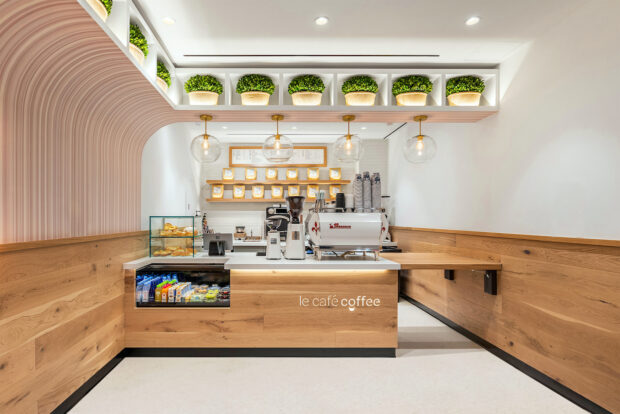
Welcome to Design Details, an ongoing editorial feature in Daily Coffee News focused on individual examples of coffee shop architecture, interior design, packaging design or branding. If you are a coffee...
Robert Downey Jr.’s New “Happy Coffee” Is Really Depressing
This article is from the coffee website Sprudge at http://sprudge.com. This is the RSS feed version. Robert Downey Jr. and Craig Dubitsky team up for Happy Coffee.
Out Now: The February + March 2024 Issue of Barista Magazine!
In our new issue we feature Lisa Lawson from Glasgow, Scotland, take a look at the newest grinders, explore spring drink inspiration, see how more women are getting involved in coffee tech, and much more! BY SARAH ALLENBARISTA MAGAZINE We’re stoked to announce the...
The coffee industry’s biggest competition: The story of the World Barista Championship
Every year, the global coffee industry gears up for one of its most exciting and groundbreaking competitions: the World Barista Championship. For more than two decades, the WBC has been one of the biggest catalysts for change and innovation in specialty coffee, and...
The 2023 Specialty Coffee Transaction Guide Has Landed
The 2023 edition of the Specialty Coffee Transaction Guide (SCTG) guide went live today, providing actors throughout the coffee chain a data-driven tool for green coffee price discovery. The full...
Espro great until I needed replacement filter ☹️
I've had an Espro P7 for nearly four years after seeing glowing praise on this sub (to which I later contributed). Before I bought the P7 I looked at the replacement parts available and they seemed like a solid company in that they sold e.g. replacement filters...
New Bill Requires More Kona In Your Kona Coffee
This article is from the coffee website Sprudge at http://sprudge.com. This is the RSS feed version. Currently a coffee only need to be 10% Kona to be labeled as such.
What’s the best and worst part about owning and running a coffee shop?
I'm not interested in getting into it myself, as I have no experience in the service industry, no real appetite for risk and no desire to run a business in general. But sometimes I think about it and I wonder what's the most enjoyable thing about it and...
minimum dose size?
I use the Hario switch to brew my coffee and am trying to reduce my caffeine consumption. Hence I would like to brew smaller cups of coffee. I am currently using 10g of coffee with 160g of water. (1:16 Ratio) I am wondering if there is a minimum amount of coffee...
[CAFE OWNERS] Background before starting a shop?
I’ve worked in coffee for 6 yrs as a barista and shift supervisor and have passion for it. I’ve decided that I want to open my own place in the future and so I’ve been doing the research to make a business plan. Lately, however, I’ve begun to realize just how many...
Fines: Fine for Espresso, Not So Fine For Filter
Every once in a while I hear or read a misunderstanding of the role of fines in coffee extraction and flavor. I’d like to discuss how coffee extracts, the role of fines in extraction, and how fines influence espresso and filter brewing differently. This is a long, technical post. But if you’re a coffee professional, it’s important you read, and probably re-read, it in its entirety. It is easy to make practical use of the ideas I present here.
If you find this post interesting or useful, please feel free to share, translate, or link to, this post.
Defining fines
A coffee bean is a complex three-dimensional matrix of cellulose strands coated with oils and other solids. These strands crisscross to form void spaces, or “cells.” Researchers estimate a typical bean contains a million such cells. Roasting makes the cellulose brittle and grinding shatters the cellulose structure into various particle sizes. We call the smallest particles “fines.”
There is some disagreement about the definition of a fine. Most of the older research papers I’ve read referred to fines as cell-wall fragments containing no intact cells. Some people define fines as particles with diameters smaller than a certain size, say 50 microns. Others have recently defined fines as the particles in a certain section (the small hump, if you will) of a particle-size-distribution curve.
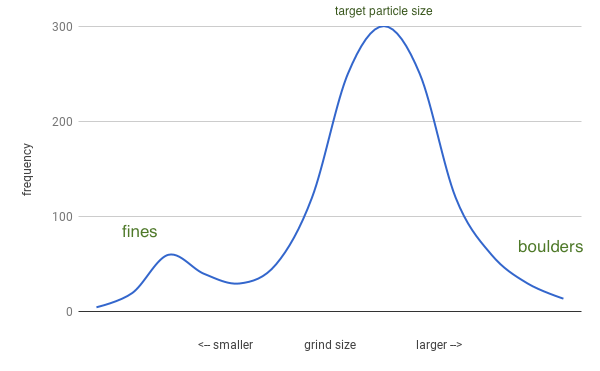
Typical particle-size distribution curve. Please ignore numbers, curve is for conceptual purposes only. Frequency here refers to weight or volume of particles.
My preferred definition of a fine is a cell-wall fragment containing no intact cells, because particles with intact cells extract differently than particles without any intact cells. Defined this way, brewing water can freely access all of the surface of the cellulose of a fine during extraction, but in particles with intact cells, some of the cellulose surface is inside the cells and not directly exposed to the water.
Choosing an arbitrary diameter-size cutoff to define fines makes little sense to me, as fines come in many different shapes, few of which are remotely spherical. Unfortunately, many scientific papers make the seemingly innocuous assumption that coffee grounds are spherical, for the sake of simplifying math and modeling extraction kinetics. That assumption is absurd and misleading, and the conclusions of such papers should be taken with a (spherical?) grain of salt.*
Looking at the little hump of a particle-size distribution curve (PSD) is an interesting way of grouping coffee grounds, but doesn’t provide an objective criteria or definition for fines, as that hump’s quantity, quality, and distribution change along with bean, roast, grinder, burr sharpness, burr alignment, etc, not to mention the method used to measure the PSD.
How coffee extraction occurs
There are two phases of coffee extraction: surface erosion and inner-particle diffusion. When water contacts a large ground-coffee particle, it rapidly dissolves coffee solids from the exposed surfaces of the particle. In perhaps a few seconds, such erosion is nearly complete.
Extraction from the intact cells within a ground occurs by diffusion, a process that takes minutes, and is never complete, at least under reasonable brewing circumstances. In diffusion, a concentration gradient causes solids to move from the particle to the water (solids will always move from an area of high concentration to a neighboring area of lower concentration.) The solids dissolved in the water then have to diffuse through the pores of the cellulose to reach the brewing liquid surrounding the particle. Inner-particle diffusion is slow because of its many steps: water must pass through the ground’s pores, dissolve solids, pass back out the pores, and ultimately carry the solids out of the coffee slurry into the brew. Extraction from larger particles is slower primarily because they have longer diffusion paths.
During a percolation process such as batch brewing, there will always be some dissolved solids left behind in the cells of the grounds, and some solids left behind in the interstitial liquid between grounds. In an immersion brew such as a French press, extraction is slower, primarily because solids-packed brewing liquid is not continually removed from the brewer, and during most of the extraction process, the concentration gradient is not as high as it is during percolation brewing. (This is why you should grind much finer for French press than for batch brewing, something that 99% of coffee professionals do not do.) As well, the liquid left behind in the coffee bed of an immersion brew contains much more dissolved solids than that of a percolation brew, making immersion brewing a less efficient extraction method than percolation. As a technical aside, the different solids concentrations remaining in the spent grounds of percolation and immersion brews is why Extract Mojo software has separate modes for calculating drip and immersion extractions. I’m happy to write more on that in another post if readers express interest.
One day we may be enjoying 30% extractions
(and I’m sure that really excites Matt.)
Approximately 35% of the mass of a coffee bean is water soluble. Without extreme temperatures, unrealistically long extraction times or additional solvents, it’s a fair to assume that you’ll never extract more than 35% of the weight of a pile of coffee grounds. Quality extractions of grounds from sub-$20,000 grinders usually top out around 23% in cafes but some massive roller-mill grinders produce grounds that readily extract a few percentage points higher.
This is speculative, but it seems that one may be able to extract about 80%—90% of the soluble solids contained on a section of cellulose (i.e., a fine) before astringency and bitterness skyrocket. Say what? It may be possible to get a delicious 30% extraction? Perhaps, but not today, and not with your EK. You may be able to get to 26% or so with a decent grinder if you grind much finer than usual, arduously sift and remove as many of the fines and “boulders” (oversized particles) as possible, and batch brew the coffee. (Please don’t rush to judge the idea based on one such brew— the odds are low that you got the grind setting, sieving, and extraction all just right— it takes practice. But when you do get it right, the results are fantastic.)
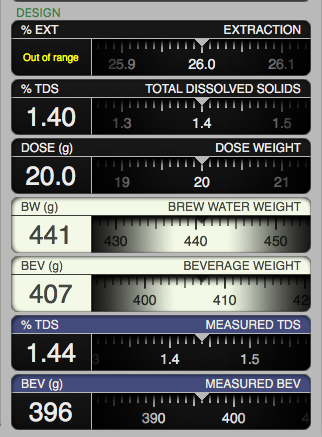
Dear Vince, we may need new software when we get to 30% extractions, as my CoffeeTools tops out at 26% :).
My contention is that if a given section of coffee cellulose is 35% soluble solids by weight, it is potentially desirable to extract 30 of that 35. (i.e. 86% of the available soluble solids), and that somewhere between 30 and 35, extraction of astringency increases dramatically. In theory, if you had a pile of fines (fully-exposed cellulose fragments) and managed to get all of the particles to extract at exactly 30%, it would be an amazing cup of coffee; but that’s probably impossible to do.
The problem is that in everyday brewing, the solids from the surfaces of grounds (i.e. all of the solids on the fines and exposed surfaces of larger particles) will extract beyond 30% in seconds, while the 80%? of coffee solids extracting by diffusion will take minutes to reach merely 20%. Additionally, it’s likely that diffusion from some smaller particles or particles along channels in the coffee bed may eclipse 30% extraction before the coffee bed’s average extraction reaches 20%.
Why all of this science stuff matters
To make the best-possible filter coffee, it’s likely you should try to minimize fines (and boulders, for what it’s worth). Given that fines are guaranteed to overextract and contribute bitterness and astringency, if you can remove fines or avoid creating them the first place, you’ll make a cleaner, sweeter cup with smoother mouthfeel. Most of us don’t enjoy astringent coffee, but if you do, that’s great, as tannins are excellent gut-bacteria modulators. I prefer to get my tannins from wine, thanks.
How to minimize fines, in order of importance:
-
Use sharper grinder burrs
-
Ensure grinder burrs are aligned as well as possible
-
Grind coarser
-
Use larger grinder burrs (burr design also matters, but larger is generally better)
-
Roast lighter
-
Avoid naturals at all costs*
-
Sift and remove the fines— this is difficult to do well, but worth experimenting with for home use and brewing competitions
-
Potentially, grind warmer coffee beans or use a warmer grinder (jury is out on this)
*Not true, but just felt like throwing that in there.
Along with minimizing fines, avoiding channeling in percolation brews is incredibly important for controlling astringency. Fines and channels affect cup quality in similar ways.
Fines are fine for espresso, to a degree
But what about espresso? Espresso extraction times are too short for extraction to occur via diffusion. Researchers have debated whether diffusion contributes at all to espresso extraction; if it does, its contribution is trivial. (I’m ignoring “espresso” made with minute-long preinfusion, “Slayer shots”, and other such non-standard practices.)
The authors of Illy’s espresso book state that fines provide the necessary extraction surface, while larger particles are required to achieve adequate flow rate through the coffee bed of an espresso. If there are too few fines, extraction is low; if there are too few large particles, flow chokes. Given that espresso requires rapid extraction via erosion, some fines are likely to be required for a decent shot. (I think it’s theoretically possible to isolate grounds in the 100–200 micron range and use them to pull a tasty fines-free shot, but that’s not practical in a cafe.) What’s the ideal proportion of fines? Of course, no one knows. To complicate the matter, there seem to be two subsets of fines; let’s call them “larger fines” and “coffee dust.” The presence of the tiniest fines, or coffee dust, probably damages espresso quality by disproportionately slowing flow rates relative to their extraction contribution, thus requiring a coarser grind setting, which in turn decreases extraction.
Chris Hendon noted on my Instagram recently that grinding frozen beans produces less coffee dust and more of the larger fines, and they are of more uniform size. I have not seen the data, but that phenomenon may explain the success many baristas claim to have with grinding frozen beans for espresso. Minimizing coffee dust and producing larger, more uniform fines would almost certainly produce superior espresso extractions. Thanks, Chris, and I hope I have represented your findings accurately.
The bottom line
Congratulations if you’ve made it through this whole post. Now please read it again so it all makes sense :). Most importantly, I hope this post convinces you to be cognizant of fines production and the ways you can minimize it when grinding for non-espresso brewing. The two most impactful things most cafes can do to immediately improve quality are to replace old, worn grinder burrs with fresh, seasoned burrs, and to align the burrs as precisely as possible. Extractions will increase, flavor clarity will improve, astringency and bitterness will decrease, and mouthfeel will be smoother.
I’d love to know your thoughts. Don’t be shy.