




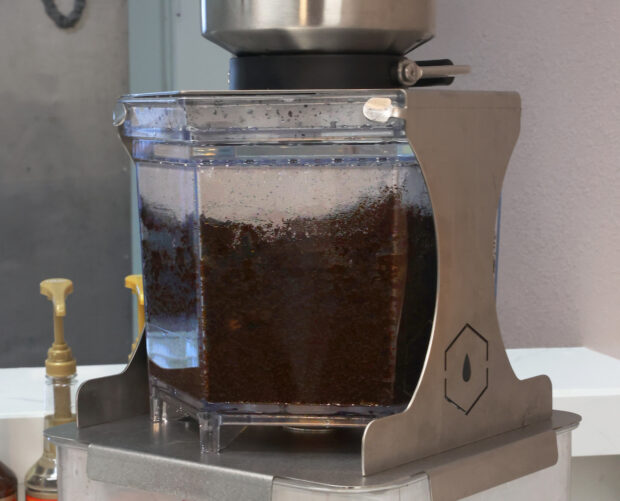


This is the absolute fastest way to make French press iced coffee. Just forget about cold brew concentrate – with this Quick French Press Iced Coffee Recipe you can have your iced coffee ready in 5 – 6 minutes. Who doesn’t like the French press?! It’s...
Non-Homogenized Milk: An Introduction
Non-Homogenized Milk: An Introduction
Non-Homogenized Milk: An Introduction
Non-Homogenized Milk: An Introduction
Non-Homogenized Milk: An Introduction
Non-Homogenized Milk: An Introduction
I Tested Keurig K Compact – Here’s Everything You Need To Know
The most affordable Keurig coffee maker is available exclusively at Walmart and comes at a sweet price of only $59.00. In this article, you’ll find out how good it really is, and also find additional information like how to clean it, or do you need a water...
Here’s How to Change Keurig 2.0 Water Filter Easily
Not sure how to change Keurig 2.0 water filter? Here are step-by-step instructions that will help you do it quickly and easily. Keurig water filter should be changed every 2 months or 60 tank refills. The water filter is located inside the water tank, on the valve at...
The coffee rose for assessing Anaerobic coffee
I just came across this really neat tool to assess anaerobic coffees. I haven't used it for cupping yet. I'm not sure I will like it either because the idea of lowering the score of the coffee just because it tastes has some thyme flavors. At the same time I...
Three US Coffee Championship Events Are Heading To Rancho Cucamonga
This article is from the coffee website Sprudge at http://sprudge.com. This is the RSS feed version. The 2024 US Barista Championship, Brewers Cup, and Cup Tasters will take place March 15-17 at Klatch Coffee Roasters in Rancho Cucamonga, California.
The Origin Story of Turtle Island Coffee in Vancouver, B.C.
A new Indigenous-owned coffee company based in Vancouver, British Columbia, called Turtle Island Coffee has launched with the goal of exposing more people to high quality specialty coffee and Indigenous...
Get Ready for The Barista League’s 2024 Season
The Barista League has announced 12 competitions across four continents. BY J. MARIE CARLANBARISTA MAGAZINE ONLINE Photos courtesy of The Barista League When The Barista…
Get Ready for The Barista League’s 2024 Season
The Barista League has announced 12 competitions across four continents. BY J. MARIE CARLANBARISTA MAGAZINE ONLINE Photos courtesy of The Barista League When The Barista…
Get Ready for The Barista League’s 2024 Season
The Barista League has announced 12 competitions across four continents. BY J. MARIE CARLANBARISTA MAGAZINE ONLINE Photos courtesy of The Barista League When The Barista League announces new events, it’s worth paying attention! This year, the schedule will be...
Weekly Coffee News: EUDR and Africa + More Celebrity Coffee
Welcome to DCN’s Weekly Coffee News. Keep up with all the latest coffee industry stories and career opportunities by subscribing to DCN’s newsletter. Tell our editors about your news here. Report: Small-Scale Farmers in...
Do Higher Coffee Prices Mean More Money For Farmers? A Story From Sumatra Shows It’s Complicated
This article is from the coffee website Sprudge at http://sprudge.com. This is the RSS feed version. Since coffee costs more now than ever, do those coffee prices impact the amount of money earned by coffee farmers?
Coffee News Recap, 2 Feb: Applications open for Australia’s Richest Barista 2024, De’Longhi reports 4.6% revenue increase after La Marzocco move & other stories
Every Friday, Perfect Daily Grind rounds up the top coffee industry news from the previous week. Here are this week’s coffee news stories. The word of the week is: expansion. Mon, 29 Jan AeroPress launches limited-edition Clear Pink brewer. The coffee brewer is made...
Watch The 8 Best Coffee Videos Vying For Sprudgie Awards
This article is from the coffee website Sprudge at http://sprudge.com. This is the RSS feed version. The best coffee videos from 2023 featuring Cafe Imports, Aramse, Nguyen Coffee Supply, Wildly, Mirror Coffee Roasters, Alto Stories, Quek Shio, and Cafe Retiro.
Robusta is great and has untapped potential
I live in the US and my typical choice of coffee is lightly roasted Ethiopian pour overs. I generally love acidity and fruit flavors in my coffee. My experience with Robusta has often been poor. Very dark, roasty and maybe chocolatey. I participated in the Hoffman...
Design Details: Brewing Reinvented at ULA Café in Melbourne
Welcome to Design Details, an ongoing editorial feature in Daily Coffee News focused on individual examples of coffee shop architecture, interior design, packaging design or branding. If you are a coffee...
Robert Downey Jr.’s New “Happy Coffee” Is Really Depressing
This article is from the coffee website Sprudge at http://sprudge.com. This is the RSS feed version. Robert Downey Jr. and Craig Dubitsky team up for Happy Coffee.
Out Now: The February + March 2024 Issue of Barista Magazine!
In our new issue we feature Lisa Lawson from Glasgow, Scotland, take a look at the newest grinders, explore spring drink inspiration, see how more women are getting involved in coffee tech, and much more! BY SARAH ALLENBARISTA MAGAZINE We’re stoked to announce the...
The coffee industry’s biggest competition: The story of the World Barista Championship
Every year, the global coffee industry gears up for one of its most exciting and groundbreaking competitions: the World Barista Championship. For more than two decades, the WBC has been one of the biggest catalysts for change and innovation in specialty coffee, and...
The 2023 Specialty Coffee Transaction Guide Has Landed
The 2023 edition of the Specialty Coffee Transaction Guide (SCTG) guide went live today, providing actors throughout the coffee chain a data-driven tool for green coffee price discovery. The full...
Espro great until I needed replacement filter ☹️
I've had an Espro P7 for nearly four years after seeing glowing praise on this sub (to which I later contributed). Before I bought the P7 I looked at the replacement parts available and they seemed like a solid company in that they sold e.g. replacement filters...
New Bill Requires More Kona In Your Kona Coffee
This article is from the coffee website Sprudge at http://sprudge.com. This is the RSS feed version. Currently a coffee only need to be 10% Kona to be labeled as such.
What’s the best and worst part about owning and running a coffee shop?
I'm not interested in getting into it myself, as I have no experience in the service industry, no real appetite for risk and no desire to run a business in general. But sometimes I think about it and I wonder what's the most enjoyable thing about it and...
minimum dose size?
I use the Hario switch to brew my coffee and am trying to reduce my caffeine consumption. Hence I would like to brew smaller cups of coffee. I am currently using 10g of coffee with 160g of water. (1:16 Ratio) I am wondering if there is a minimum amount of coffee...
[CAFE OWNERS] Background before starting a shop?
I’ve worked in coffee for 6 yrs as a barista and shift supervisor and have passion for it. I’ve decided that I want to open my own place in the future and so I’ve been doing the research to make a business plan. Lately, however, I’ve begun to realize just how many...
Non-Homogenized Milk: An Introduction
Not all milks are alike; here’s the scoop on homogenization and how it affects baristas.
BY TANYA NANETTI
SENIOR ONLINE CORRESPONDENT
Cover photo by Nikolai Chernichenko via Unsplash
Milk is familiar to most of us. Not just a drink for children, it’s also often consumed by adults and is of course one of the key ingredients at cafés. But you may be unfamiliar with the processing that milk undergoes before reaching the market, and one such process is homogenization.
The Process of Homogenization
Albert Straus is the CEO of Straus Family Creamery, a mission-driven company launched in 1994. They have a deep commitment to supporting an organic dairy farming system that is both environmentally friendly and economically viable.
Albert shares a brief explanation of basic milk processing: “Cows produce whole milk with two components: nonfat milk and cream. Left to settle, the cream naturally rises to the top. This is what happens in nature; then, before arriving on the market, most of the milks are ultra-pasteurized to increase shelf life, which involves ’cooking’ the milk at high temperature (at or above 280° F for at least 2 seconds). These more heavily processed milks forfeit flavor and nutritional integrity in their quest for a longer shelf life.”
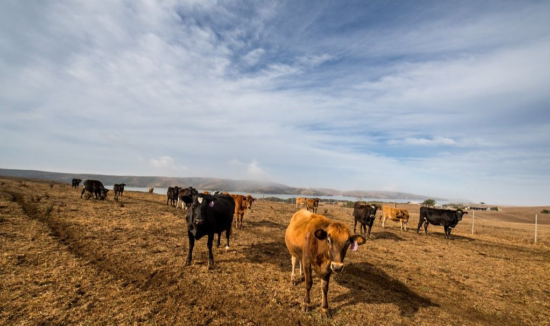
Photo courtesy of Straus Family Creamery.
But not all dairy companies process milk heavily, and as Albert tells us, some dairy brands act differently—Straus Family Creamery’s organic milk is never ultra-pasteurized.
“It’s gently crafted with a high-temperature short time (HTST) pasteurization method at 168° F for 18 seconds. This process destroys harmful bacteria while still preserving the authentic flavor of the milk: a sweet, fresh, well-rounded taste,” he says.
Albert, who grew up on a dairy farm drinking raw milk straight from the cows’ milking barn, prefers to keep Straus organic milk as close as possible to its origin. They process their milk with no preservatives or additives, and for most of the dairy offered, without homogenization. Non-homogenized milk is as close to its natural taste and texture as possible, with the cream naturally floating on top.
To Homogenize or Not?
“We believe in delivering the highest-quality organic dairy products that are minimally processed, and that’s why all Straus Organic Cream-Top milk sold in grocery stores is non-homogenized,” Albert says. ”The only homogenized milks (we offer) are Straus Organic Half & Half, Organic Chocolate Milk, and Organic Eggnog, where homogenization is needed to fully blend the ingredients.”
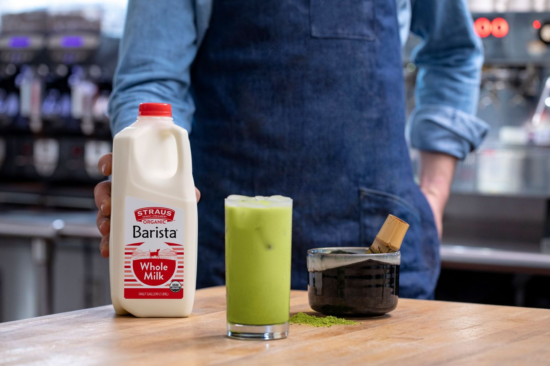
Another exception to non-homogenized milk is Straus Organic Barista, which the company specially designs to be used in the professional environment of coffee and tea shops.
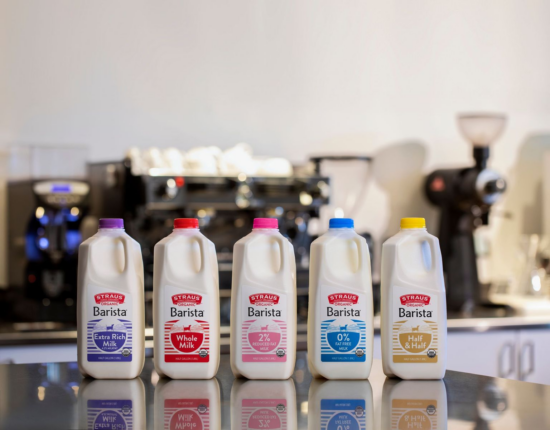
Photo courtesy of Straus Family Creamery.
“Straus Organic Barista milk is lightly homogenized, meaning the fat is mixed with the milk so that the cream no longer separates,” Albert says. ”Our barista customers rely heavily on the consistency of flavor and performance of the milk they pour. Straus Organic Barista milk … ensures consistency in every pour and allows baristas to create rich-tasting custom beverages with long-lasting, glossy microfoam.”
A Barista’s Experience
While brands like Straus Family Creamery decide to slightly homogenize milk specially designed for baristas, some farms choose a different approach. In Germany, brands like Brodowin—an organic farm located less than 50 miles from Berlin—offer non-homogenized milks for professional use in coffee shops and restaurants. Brodowin bottles a fully non-homogenized, full-cream milk with at least 3.7% fat that has become the reference milk for most of the Berlin specialty-coffee scene. They deliver milk in disposable bags made of Calymer, a tear-resistant material that consists of 40% chalk, which weighs only 16g per bag and is easily recycled. Brodowin’s full-cream milk is incredibly tasty and creamy; however, it can be a challenge for new-in-town baristas who are learning to steam it for the first time.
Johannes Otto, head barista at Rösttrommel Kaffeerösterei in Nuremberg and Germany Latte Art Champion 2020, helps us understand why.
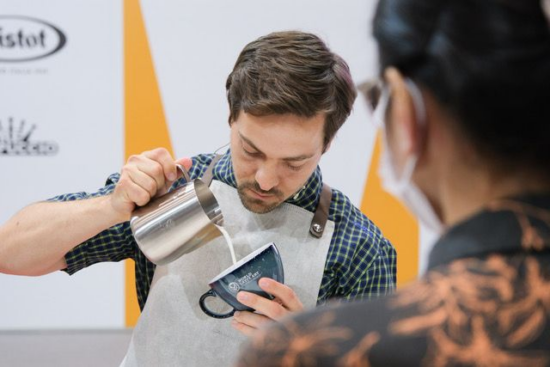
Photo courtesy of Johannes Otto.
“In our cafés, we work with fresh organic milk, not homogenized, that comes directly from the producer,” Johannes explains. “This is the best quality you can get. But it can also be a bit challenging because you always have the fat swimming on top and the watery part below. We get our milk delivered in 10-liter buckets and you always have to give it a good shake before use.”
Johannes, who has also worked with homogenized milk for latte art competition training, can easily explain the difference between the two kinds of milk. “Handling homogenized milk is obviously much easier, because every drop is basically the same. But still, I prefer the not-homogenized milk because it has gone through fewer processes, which is better for natural quality, and I’m always looking for quality.”
He adds, “Every process that milk runs through changes its natural taste, and that’s why in my opinion not-homogenized milk tastes fresher than homogenized. In terms of milk frothing, non-homogenized milk is creamier and silkier, and when properly shaken, produces a shinier milk foam.”
In June 2019, during the World Latte Art Championship, many competitors were surprised by the non-homogenized milk used for the competition.
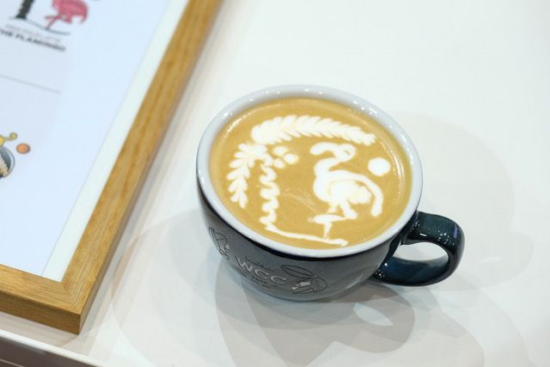
Photo courtesy of Johannes Otto.
“I think it was something new for the competitors and something that no one had planned,” Johannes says. “As far as I can remember, it was milk at a quality level called Demeter, which is a step up from organic. This quality doesn’t allow homogenization, because it aims to be processed [as little] as possible. For a competition where consistency is the key, it is obviously [harder] to work with, but in reality the only thing you need to change while frothing is just to keep the stretching part a little longer than usual. The foam doesn’t build up so quickly in non-homogenized milk. After that, it’s pretty much the same to work with: I even think that non-homogenized milk has a finer, silkier foam structure perfect for advanced latte art.”
Johannes concludes: “Non-homogenized milk is still perfectly steamable if you just shake the milk first to re-incorporate the fat. That’s the key.”
ABOUT THE AUTHOR
Tanya Nanetti (she/her) is a specialty-coffee barista, a traveler, and a dreamer. When she’s not behind the coffee machine (or visiting some hidden corner of the world), she’s busy writing for Coffee Insurrection, a website about specialty coffee that she’s creating along with her boyfriend.
The post Non-Homogenized Milk: An Introduction appeared first on Barista Magazine Online.