



This is the absolute fastest way to make French press iced coffee. Just forget about cold brew concentrate – with this Quick French Press Iced Coffee Recipe you can have your iced coffee ready in 5 – 6 minutes. Who doesn’t like the French press?! It’s...
Drip vs. Immersion: We May Be Calculating Extraction Incorrectly! And, A Contest.
Drip vs. Immersion: We May Be Calculating Extraction Incorrectly! And, A Contest.
Drip vs. Immersion: We May Be Calculating Extraction Incorrectly! And, A Contest.
Drip vs. Immersion: We May Be Calculating Extraction Incorrectly! And, A Contest.
Drip vs. Immersion: We May Be Calculating Extraction Incorrectly! And, A Contest.
Drip vs. Immersion: We May Be Calculating Extraction Incorrectly! And, A Contest.
I Tested Keurig K Compact – Here’s Everything You Need To Know
The most affordable Keurig coffee maker is available exclusively at Walmart and comes at a sweet price of only $59.00. In this article, you’ll find out how good it really is, and also find additional information like how to clean it, or do you need a water...
Here’s How to Change Keurig 2.0 Water Filter Easily
Not sure how to change Keurig 2.0 water filter? Here are step-by-step instructions that will help you do it quickly and easily. Keurig water filter should be changed every 2 months or 60 tank refills. The water filter is located inside the water tank, on the valve at...
The coffee rose for assessing Anaerobic coffee
I just came across this really neat tool to assess anaerobic coffees. I haven't used it for cupping yet. I'm not sure I will like it either because the idea of lowering the score of the coffee just because it tastes has some thyme flavors. At the same time I...
Three US Coffee Championship Events Are Heading To Rancho Cucamonga
This article is from the coffee website Sprudge at http://sprudge.com. This is the RSS feed version. The 2024 US Barista Championship, Brewers Cup, and Cup Tasters will take place March 15-17 at Klatch Coffee Roasters in Rancho Cucamonga, California.
The Origin Story of Turtle Island Coffee in Vancouver, B.C.
A new Indigenous-owned coffee company based in Vancouver, British Columbia, called Turtle Island Coffee has launched with the goal of exposing more people to high quality specialty coffee and Indigenous...
Get Ready for The Barista League’s 2024 Season
The Barista League has announced 12 competitions across four continents. BY J. MARIE CARLANBARISTA MAGAZINE ONLINE Photos courtesy of The Barista League When The Barista…
Get Ready for The Barista League’s 2024 Season
The Barista League has announced 12 competitions across four continents. BY J. MARIE CARLANBARISTA MAGAZINE ONLINE Photos courtesy of The Barista League When The Barista…
Get Ready for The Barista League’s 2024 Season
The Barista League has announced 12 competitions across four continents. BY J. MARIE CARLANBARISTA MAGAZINE ONLINE Photos courtesy of The Barista League When The Barista League announces new events, it’s worth paying attention! This year, the schedule will be...
Weekly Coffee News: EUDR and Africa + More Celebrity Coffee
Welcome to DCN’s Weekly Coffee News. Keep up with all the latest coffee industry stories and career opportunities by subscribing to DCN’s newsletter. Tell our editors about your news here. Report: Small-Scale Farmers in...
Do Higher Coffee Prices Mean More Money For Farmers? A Story From Sumatra Shows It’s Complicated
This article is from the coffee website Sprudge at http://sprudge.com. This is the RSS feed version. Since coffee costs more now than ever, do those coffee prices impact the amount of money earned by coffee farmers?
Coffee News Recap, 2 Feb: Applications open for Australia’s Richest Barista 2024, De’Longhi reports 4.6% revenue increase after La Marzocco move & other stories
Every Friday, Perfect Daily Grind rounds up the top coffee industry news from the previous week. Here are this week’s coffee news stories. The word of the week is: expansion. Mon, 29 Jan AeroPress launches limited-edition Clear Pink brewer. The coffee brewer is made...
Watch The 8 Best Coffee Videos Vying For Sprudgie Awards
This article is from the coffee website Sprudge at http://sprudge.com. This is the RSS feed version. The best coffee videos from 2023 featuring Cafe Imports, Aramse, Nguyen Coffee Supply, Wildly, Mirror Coffee Roasters, Alto Stories, Quek Shio, and Cafe Retiro.
Robusta is great and has untapped potential
I live in the US and my typical choice of coffee is lightly roasted Ethiopian pour overs. I generally love acidity and fruit flavors in my coffee. My experience with Robusta has often been poor. Very dark, roasty and maybe chocolatey. I participated in the Hoffman...
Design Details: Brewing Reinvented at ULA Café in Melbourne
Welcome to Design Details, an ongoing editorial feature in Daily Coffee News focused on individual examples of coffee shop architecture, interior design, packaging design or branding. If you are a coffee...
Robert Downey Jr.’s New “Happy Coffee” Is Really Depressing
This article is from the coffee website Sprudge at http://sprudge.com. This is the RSS feed version. Robert Downey Jr. and Craig Dubitsky team up for Happy Coffee.
Out Now: The February + March 2024 Issue of Barista Magazine!
In our new issue we feature Lisa Lawson from Glasgow, Scotland, take a look at the newest grinders, explore spring drink inspiration, see how more women are getting involved in coffee tech, and much more! BY SARAH ALLENBARISTA MAGAZINE We’re stoked to announce the...
The coffee industry’s biggest competition: The story of the World Barista Championship
Every year, the global coffee industry gears up for one of its most exciting and groundbreaking competitions: the World Barista Championship. For more than two decades, the WBC has been one of the biggest catalysts for change and innovation in specialty coffee, and...
The 2023 Specialty Coffee Transaction Guide Has Landed
The 2023 edition of the Specialty Coffee Transaction Guide (SCTG) guide went live today, providing actors throughout the coffee chain a data-driven tool for green coffee price discovery. The full...
Espro great until I needed replacement filter ☹️
I've had an Espro P7 for nearly four years after seeing glowing praise on this sub (to which I later contributed). Before I bought the P7 I looked at the replacement parts available and they seemed like a solid company in that they sold e.g. replacement filters...
New Bill Requires More Kona In Your Kona Coffee
This article is from the coffee website Sprudge at http://sprudge.com. This is the RSS feed version. Currently a coffee only need to be 10% Kona to be labeled as such.
What’s the best and worst part about owning and running a coffee shop?
I'm not interested in getting into it myself, as I have no experience in the service industry, no real appetite for risk and no desire to run a business in general. But sometimes I think about it and I wonder what's the most enjoyable thing about it and...
minimum dose size?
I use the Hario switch to brew my coffee and am trying to reduce my caffeine consumption. Hence I would like to brew smaller cups of coffee. I am currently using 10g of coffee with 160g of water. (1:16 Ratio) I am wondering if there is a minimum amount of coffee...
[CAFE OWNERS] Background before starting a shop?
I’ve worked in coffee for 6 yrs as a barista and shift supervisor and have passion for it. I’ve decided that I want to open my own place in the future and so I’ve been doing the research to make a business plan. Lately, however, I’ve begun to realize just how many...
Drip vs. Immersion: We May Be Calculating Extraction Incorrectly! And, A Contest.
Several readers recently requested a post explaining the differences in measuring extractions of drip vs. immersion brews. I have always wanted to write about this, but didn’t think anyone would want to read such a post :). I’m glad I’ve got a few geeky readers out there.
Writing this post got me to thinking, measuring, and questioning. What I found was shocking, so I discussed it with my friend Dan Eils, who’s a brilliant scientist with a keen interest in coffee making. I think Dan and I are onto something, and it implies we all may be calculating extractions incorrectly. This post wouldn’t have been possible without Dan’s help and our enjoyable week-long debate over these issues.
This post will take some effort to fully grasp, but if you measure extractions, I think it’s essential to read this and discuss it. Comments are welcome, and sharing this post with other coffee pros is also welcome, as I’d like to get feedback and ideas from many sources. My hope is that the ideas in this post reshape how we calculate extraction and also help users of the coffee refractometer understand the numbers a little better. I also hope that others will point out any errors in my thinking or calculations.
First, a little primer…
Concentration Gradient
When water mixes with coffee grounds, coffee solids dissolve in the water and move from the grounds to the surrounding slurry by diffusion. (This does not apply to espresso.) The rate of diffusion is determined primarily by the concentration gradient: the difference in solids concentration between the grounds and the slurry. The higher the gradient, the faster extraction will occur.
Immersion Brewing
During immersion brewing, upon water contacting the grounds, the concentration of coffee solids in the slurry increases rapidly, and then continues to increase at a progressively slower rate, asymptotically, for the rest of the brew. An example of this is how the color of coffee in a French press hardly looks much darker from a few seconds into the brew until a few minutes later. Another example is how in cupping, brew strength doesn’t change much in the time window of 9:00–-20:00 in which you likely slurp and spit.
Brew and serve a French press, and you’ll notice that the strength of the coffee left behind in the grounds (the “interstitial liquid”) is nearly identical to the strength of the coffee in the cup. If you were to squeeze the grounds at the bottom of a French press after decanting, the strength of the liquid that oozes out would be approximately the strength of the liquid in the coffee served, or perhaps slightly stronger.
Percolation brewing
Percolation refers to brews in which liquid extracts coffee solids by passing through the bed of grounds. Just to be clear, I’m not referring to those nasty old “percolators” you may remember your mom breaking out for large gatherings when you were a kid. And trust me, there are few more memorable aromas than baked-in, rancid robusta oils from a dirty percolator in 1977.
In a percolation method such as batch brew, during most of the brewing cycle, fresh, clean water is added to the slurry while solids-packed liquid leaves the slurry. That causes the slurry’s solids concentration to decrease throughout the brew. So, while the strength of the slurry of a French press is always getting stronger, the strength of a slurry during percolation is always getting weaker. This is important, and is the primary reason percolation is a more efficient extraction method than immersion.
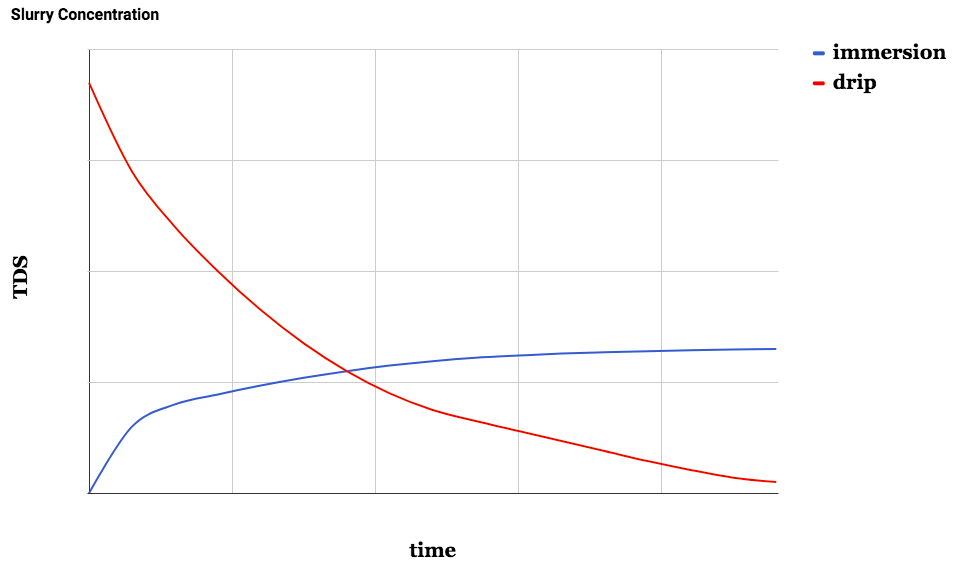
Curves are for conceptual purposes only; they were not derived from real-world data
Why your software has separate modes for drip and immersion
This is a short version of what I was taught years ago:
At the completion of a percolation brew, the slurry’s TDS is extremely low. Therefore, when considering how much coffee solids extracted during a percolation brew, you can more or less ignore the dissolved solids remaining in the slurry liquid. That is why Extract Mojo software (aka Coffee Tools) uses the brewed-coffee weight as the multiplier for the TDS to determine total extraction– almost all of the extracted solids are in the cup.
Standard percolation extraction measurement:

When measuring the extraction of an immersion brew, the liquid left in the slurry is full-strength coffee (or possibly a tad stronger). Even though those solids still seem to be in the grounds, a good deal are in the interstitial liquid, which is really liquid packed with extracted solids that just never made it into the cup. That is why the software uses the brew-water weight to calculate the extraction of an immersion brew: the slurry liquid is just like brewed coffee left behind in the filter.
Standard immersion extraction measurement:

Theory vs. Reality
Here’s the surprising part: I decided to sample a few ml’s of liquid from the spent grounds of a few v60s and batch brews, and they measured anywhere from 0.8%–1.3% TDS. For reference, the brews were all in the 1.3%–1.4% range. This shocked me: you know how the last bit of liquid flowing from the basket in a batch brew looks like very weak coffee? It is, but whether due to channeling or the slowness of diffusion or some other reason, it’s apparent that the liquid left behind in the slurry is stronger than the last, weak bits of coffee that flow from the basket during a brew.
Let’s say the slurry liquid of a percolation brew is 1.0% TDS. If the slurry liquid weighs approximately twice as much as the dry grounds, counting the extracted solids in that liquid would have a big impact your extraction calculations. I think our calculation method may need adjusting.
Two liquids in the slurry
If you use Coffee Tools software, you’ve seen the term LRR: liquid retained ratio. LRR varies with brewing method: the coarser grind of a batch brew holds a touch less liquid than the finer grounds of a v60, and a siphon has a very low LRR due to suction literally vacuuming the interstitial liquid from the coffee bed. For the sake of this discussion, let’s keep it simple and assume a percolation LRR of 2g/g of dry grounds.
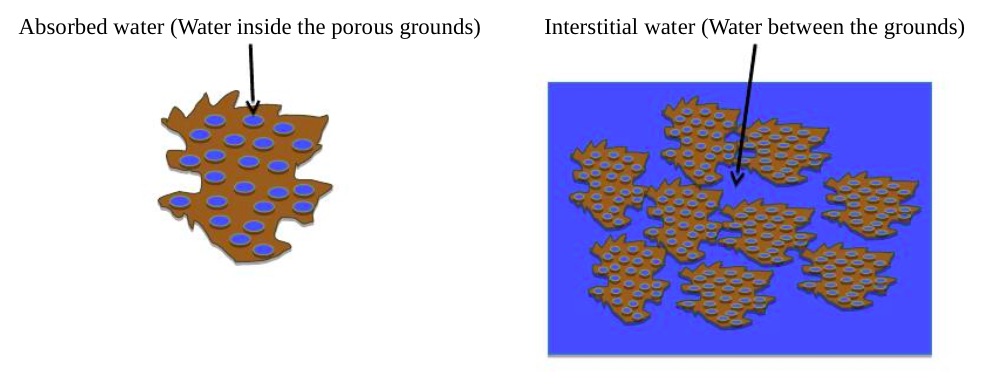
It’s speculative, but Dan and I agree that the liquid trapped within the grounds at the end of a brew is probably pretty strong, or at least stronger than the interstitial liquid. If you begin with one gram of dry grounds, you may end up with approximately one gram of strong liquid trapped in the grounds and one gram of weaker interstitial liquid. The solids in the liquid trapped within the grounds are, by definition, not extracted, so they should not be a part of any extraction calculation. The relevance of the solids within the interstitial liquid is more debatable.
A Proposal
For the five of you who made it this far, thanks for hanging in there. And I’m sorry you don’t have better things to do than to read my blog. 🙂
I propose that we consider changing the way we calculate extraction. I think we should try to count the interstitial slurry liquid, but not the liquid trapped within the grounds, in our calculations. The current equation to calculate immersion extraction counts the solids-packed liquid still trapped within the grounds, but it probably shouldn’t. Likewise, the percolation calculation doesn’t count the extracted solids in the interstitial liquid, but it probably should.
Modified extraction calculations
Percolation (we’ve added the weight of the interstitial liquid)
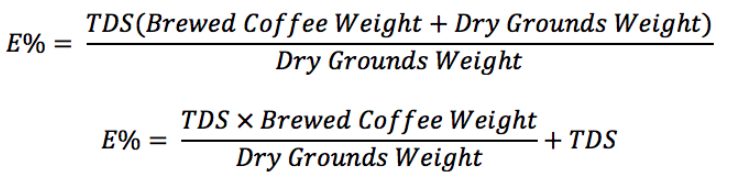
The two equations above are the same, the second is just the reduction of the first.
We have added the dry-ground weight to the multiplier here because that happens to be about the weight of the interstitial liquid. This modification is flawed in that the interstitial liquid’s TDS is likely a little lower than that of the brewed coffee. I don’t have enough data to say how much we should adjust that liquid’s TDS; it’s likely that its TDS will typically be about 75% of that of the brew’s, and perhaps we should use .75 x the dry coffee weight instead, which would make the total adjustment + .75*TDS. The jury is out. (Please realize the extraction increased by a tidy 1 x TDSsimply because of our assumption about the amount of interstitial liquid.)
Immersion (we’ve subtracted the weight of the liquid trapped within the grounds)
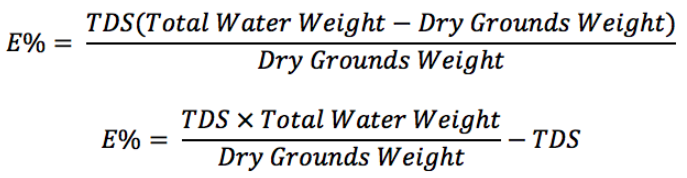
The second equation above is a reduction of the first. We have subtracted the dry ground weight from the multiplier because that is also the approximate weight of the liquid trapped within the grounds.
Two examples
Percolation: Let’s say you measure a v60 made from 20g grounds and 360g water, with a brewed-coffee weight of 320g and TDS of 1.4%.
By the old method, the extraction would be 22.4% (320 x 0.014 / 20 = .224 = 22.4%)
By the new formula, the extraction calculation would be 23.8% (just add the TDS to the extraction %)
Immersion: Let’s say you brew a French Press with 20g grounds, 360g water, and TDS = 1.4%
By the old formula, the extraction would be 25.2%
By the new formula, the extraction would be 23.8%
The Fudge Factor
This method is not precise, given that we’re estimating, and probably overstating, the TDS in the slurry liquid of percolation brews, and we’re assuming a very tidy scenario of LRR=2 with exactly half of it in the grounds, half in the interstitial liquid. In other words, the fact that both methods showed 23.8% is mostly a fudge. The calculations would have to be adjusted for brewing methods like siphon or espresso, as they have a LRR of approximately 1, so I would use the old percolation formula for them. Dan and I have wrestled with this issue for a few days, and we agree that any extraction numbers are only relevant in context (grinder, brewing method, etc) and that there is no perfect method for doing this. Some cynics will say that calculating extraction is worthless because the numbers are a somewhat malleable, or because they need context. Those same people must prefer to roast without a bean probe or Cropster, as roasting data suffers from even more imprecision and need for context. There will always be doubters, and that’s okay. Those of us who have been diligently measuring extractions for years have reaped tremendous benefits in our understanding of coffee making and our ability to communicate about brewing.
Conclusion
I’m sure the two people still reading are wondering things like “do we really need this complication” and “why doesn’t Rao have a life?” Both are excellent questions and I don’t know the answer to either. I like that this new method resolves the differences in the extraction calculations of drip and immersion brews. It’s also possible, though I don’t have any experience to confirm this, that your subjective ideal extraction numbers for a drip and immersion brew for a given coffee will get closer. That’s not too important, but it would be a nice perk. (sorry)