

This is the absolute fastest way to make French press iced coffee. Just forget about cold brew concentrate – with this Quick French Press Iced Coffee Recipe you can have your iced coffee ready in 5 – 6 minutes. Who doesn’t like the French press?! It’s...
The happy medium amount of fines
The happy medium amount of fines
The happy medium amount of fines
The happy medium amount of fines
The happy medium amount of fines
The happy medium amount of fines
I Tested Keurig K Compact – Here’s Everything You Need To Know
The most affordable Keurig coffee maker is available exclusively at Walmart and comes at a sweet price of only $59.00. In this article, you’ll find out how good it really is, and also find additional information like how to clean it, or do you need a water...
Here’s How to Change Keurig 2.0 Water Filter Easily
Not sure how to change Keurig 2.0 water filter? Here are step-by-step instructions that will help you do it quickly and easily. Keurig water filter should be changed every 2 months or 60 tank refills. The water filter is located inside the water tank, on the valve at...
The coffee rose for assessing Anaerobic coffee
I just came across this really neat tool to assess anaerobic coffees. I haven't used it for cupping yet. I'm not sure I will like it either because the idea of lowering the score of the coffee just because it tastes has some thyme flavors. At the same time I...
Three US Coffee Championship Events Are Heading To Rancho Cucamonga
This article is from the coffee website Sprudge at http://sprudge.com. This is the RSS feed version. The 2024 US Barista Championship, Brewers Cup, and Cup Tasters will take place March 15-17 at Klatch Coffee Roasters in Rancho Cucamonga, California.
The Origin Story of Turtle Island Coffee in Vancouver, B.C.
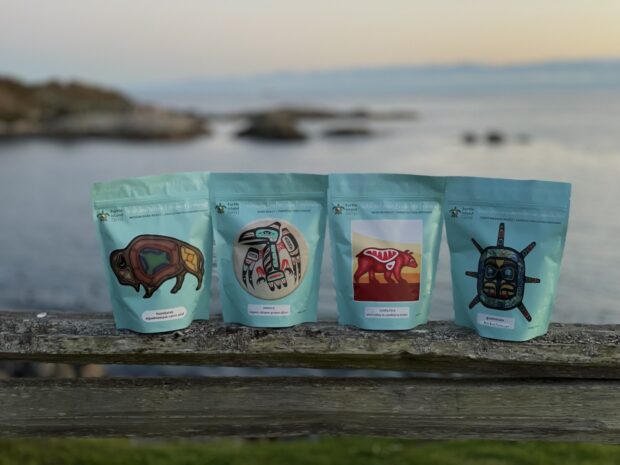
A new Indigenous-owned coffee company based in Vancouver, British Columbia, called Turtle Island Coffee has launched with the goal of exposing more people to high quality specialty coffee and Indigenous...
Get Ready for The Barista League’s 2024 Season
The Barista League has announced 12 competitions across four continents. BY J. MARIE CARLANBARISTA MAGAZINE ONLINE Photos courtesy of The Barista League When The Barista…
Get Ready for The Barista League’s 2024 Season
The Barista League has announced 12 competitions across four continents. BY J. MARIE CARLANBARISTA MAGAZINE ONLINE Photos courtesy of The Barista League When The Barista…
Get Ready for The Barista League’s 2024 Season
The Barista League has announced 12 competitions across four continents. BY J. MARIE CARLANBARISTA MAGAZINE ONLINE Photos courtesy of The Barista League When The Barista League announces new events, it’s worth paying attention! This year, the schedule will be...
Weekly Coffee News: EUDR and Africa + More Celebrity Coffee
Welcome to DCN’s Weekly Coffee News. Keep up with all the latest coffee industry stories and career opportunities by subscribing to DCN’s newsletter. Tell our editors about your news here. Report: Small-Scale Farmers in...
Do Higher Coffee Prices Mean More Money For Farmers? A Story From Sumatra Shows It’s Complicated
This article is from the coffee website Sprudge at http://sprudge.com. This is the RSS feed version. Since coffee costs more now than ever, do those coffee prices impact the amount of money earned by coffee farmers?
Coffee News Recap, 2 Feb: Applications open for Australia’s Richest Barista 2024, De’Longhi reports 4.6% revenue increase after La Marzocco move & other stories
Every Friday, Perfect Daily Grind rounds up the top coffee industry news from the previous week. Here are this week’s coffee news stories. The word of the week is: expansion. Mon, 29 Jan AeroPress launches limited-edition Clear Pink brewer. The coffee brewer is made...
Watch The 8 Best Coffee Videos Vying For Sprudgie Awards
This article is from the coffee website Sprudge at http://sprudge.com. This is the RSS feed version. The best coffee videos from 2023 featuring Cafe Imports, Aramse, Nguyen Coffee Supply, Wildly, Mirror Coffee Roasters, Alto Stories, Quek Shio, and Cafe Retiro.
Robusta is great and has untapped potential
I live in the US and my typical choice of coffee is lightly roasted Ethiopian pour overs. I generally love acidity and fruit flavors in my coffee. My experience with Robusta has often been poor. Very dark, roasty and maybe chocolatey. I participated in the Hoffman...
Design Details: Brewing Reinvented at ULA Café in Melbourne
Welcome to Design Details, an ongoing editorial feature in Daily Coffee News focused on individual examples of coffee shop architecture, interior design, packaging design or branding. If you are a coffee...
Robert Downey Jr.’s New “Happy Coffee” Is Really Depressing
This article is from the coffee website Sprudge at http://sprudge.com. This is the RSS feed version. Robert Downey Jr. and Craig Dubitsky team up for Happy Coffee.
Out Now: The February + March 2024 Issue of Barista Magazine!
In our new issue we feature Lisa Lawson from Glasgow, Scotland, take a look at the newest grinders, explore spring drink inspiration, see how more women are getting involved in coffee tech, and much more! BY SARAH ALLENBARISTA MAGAZINE We’re stoked to announce the...
The coffee industry’s biggest competition: The story of the World Barista Championship
Every year, the global coffee industry gears up for one of its most exciting and groundbreaking competitions: the World Barista Championship. For more than two decades, the WBC has been one of the biggest catalysts for change and innovation in specialty coffee, and...
The 2023 Specialty Coffee Transaction Guide Has Landed
The 2023 edition of the Specialty Coffee Transaction Guide (SCTG) guide went live today, providing actors throughout the coffee chain a data-driven tool for green coffee price discovery. The full...
Espro great until I needed replacement filter ☹️
I've had an Espro P7 for nearly four years after seeing glowing praise on this sub (to which I later contributed). Before I bought the P7 I looked at the replacement parts available and they seemed like a solid company in that they sold e.g. replacement filters...
New Bill Requires More Kona In Your Kona Coffee
This article is from the coffee website Sprudge at http://sprudge.com. This is the RSS feed version. Currently a coffee only need to be 10% Kona to be labeled as such.
What’s the best and worst part about owning and running a coffee shop?
I'm not interested in getting into it myself, as I have no experience in the service industry, no real appetite for risk and no desire to run a business in general. But sometimes I think about it and I wonder what's the most enjoyable thing about it and...
minimum dose size?
I use the Hario switch to brew my coffee and am trying to reduce my caffeine consumption. Hence I would like to brew smaller cups of coffee. I am currently using 10g of coffee with 160g of water. (1:16 Ratio) I am wondering if there is a minimum amount of coffee...
[CAFE OWNERS] Background before starting a shop?
I’ve worked in coffee for 6 yrs as a barista and shift supervisor and have passion for it. I’ve decided that I want to open my own place in the future and so I’ve been doing the research to make a business plan. Lately, however, I’ve begun to realize just how many...
The happy medium amount of fines
In the past few years, several well-known coffee experts, scientists, and grinder manufacturers have measured and publicly discussed grind particle-size distributions. Some have even rented or borrowed expensive machines that offer relatively precise measurements. Despite the increased interest in PSDs, our understanding of how burr geometry affects PSD is rather crude, and I don’t believe any of us have a clear idea of what an optimal PSD looks like. We may be vaguely aware of wanting fewer fines for filter coffee than espresso, and there is general agreement that “boulders” (particles much larger than the average) are undesirable, but to my knowledge, no one has quantified optimal fines levels with any precision, nor does anyone know much about the impact on the cup of “micro fines” vs larger fines.
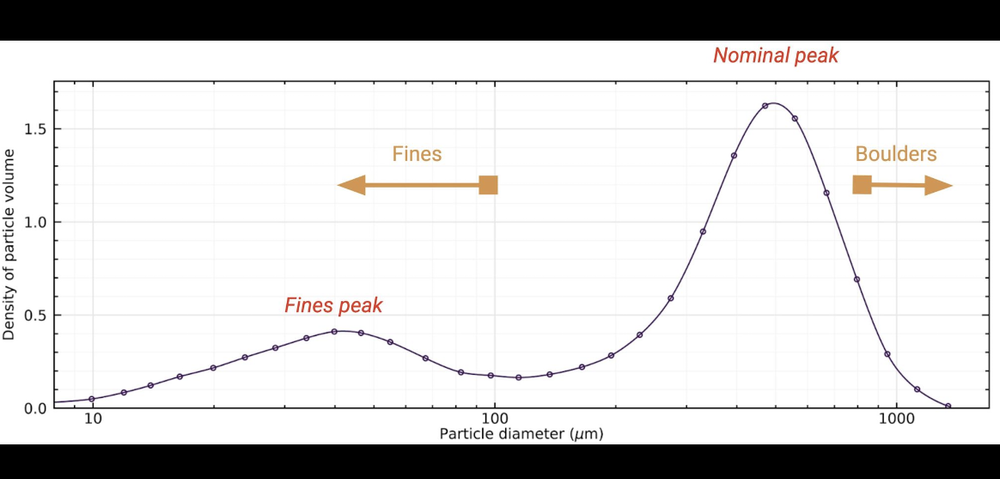
Along the way, thanks mostly to the work of Jonathan Gagné, author of The Physics of Filter Coffee, we have come to understand more about how fines affect channeling and liquid flow in percolation brewing. According to Illy in Espresso Coffee: The Science of Quality, “finer particles enhance the exposed extraction surface and the coarser ones allow the water flow.” In The Physics of Filter Coffee and on his blog Coffee Ad Astra, Jonathan elaborated on the role of fines in percolation, including dynamics related to fines migration and channeling. I recently asked Jonathan for his current thoughts on fines and he said: “When there is an insufficient proportion of fines, it causes larger, uneven gaps between particles.” Jonathan agrees that having too many fines can cause channeling, and having too few fines leaves too much large, open flow paths for astringent particles to travel out of the coffee bed. Fines fill the gaps between larger particles and help limit the amount, and perhaps size, of low-density flow paths within the coffee bed.
I’m not a scientist, but I have 30 years of experience in coffee and have personally brewed more than one million cups, which has given me some insights. What I discuss in this post is a speculation I call the “happy medium theory of fines.”
In my experience:
-
When there is an excessive proportion of fines, many flow paths clog easily, and water must find channels through which to bypass the clogged areas. These channels result in undesired astringency.
-
When there is an insufficient proportion of fines, large flow paths form in the coffee bed, and a disproportionate amount of water exits the bed through those paths, lowering brew strength, and carrying larger, astringent compounds into the cup.
-
The “happy medium” amount of fines provides enough fines to even out the size of gaps between larger coffee particles, but not so many fines that excessive, localized clogging occurs.
-
The happy medium amount of fines for a given brewing situation is the amount that minimizes astringency.
-
Optimal espresso percolation requires a greater proportion of fines than filter-coffee percolation does.
Burr types
Coffee grinders almost always use one of three types of burrs: flat (disc), conical, or roller. Flat burrs usually produce a modest amount of fines. Exceptions include “Turkish” burrs, and other burr sets designed for espresso and Turkish coffee; for the rest of this article, “flat burrs” will refer to the more common flat burrs designed for filter coffee. Conical burrs generally produce more fines than flat burrs do. Roller mills produce an average amount of fines, and the lowest proportion of boulders, assuming the beans are passed through more than one set of rollers.
In Everything But Espresso, I proposed the idea that flavor clarity and body are always in opposition. That idea has stood the test of time. Whether one changes a brewing method, filtration type, or grinder, gains in clarity always coincide with loss of body, and vice versa.

This diagram first appeared in Everything But Espresso, 2009. These days, there is a greater variety of paper filters than when I created the diagram, so the “paper filter drip” circle would be much larger. I probably messed up the positions of Clover and Chemex relative to each other, but hopefully the reader gets the gist of the diagram.
Note: when I wrote Everything But Espresso, the Vac Pot, Clover, and Eva Solo were quite popular; if I were to update the diagram, I would delete those brew methods and add the Aeropress and the forthcoming NextLevel Pulsar.
Coffee professionals often recommend flat burrs for enhanced flavor clarity, and conical burrs for increased body. However, in the past year, I’ve come to believe there is a third aspect of grind quality to consider: astringency. Astringency is the puckery or dry sensation one often experiences in the mouth when drinking wine, tea, coffee, and consuming many other foods or beverages. While astringency is welcome in wine, it is less desirable in tea, and very undesirable in coffee. Personally, any detectable astringency ruins my enjoyment of coffee.
The consensus beliefs that 1) flat burrs are good for filter and conicals are bad and 2) that low-fines flat burrs are better for filter than high-fines flat burrs, are too simplistic. While I wouldn’t sacrifice clarity for body, I’m willing to give up a little flavor clarity if it means decreasing or eliminating astringency. For example, I have never enjoyed percolation brews from “ultra-low-fines burrs” because every cup I have had from them was too astringent for my taste. Likewise, while many have criticized a grinder like the Niche Zero as having too little clarity for filter coffee, I find the Niche’s balance of clarity, body, and astringency acceptable with some brewing methods because it tends to produce very little astringency.
Note that having an adequately deep and intact coffee bed, which is rare in pourover brewing, helps to enhance clarity and limit astringency. For example, on the recent Decent Espresso Tour in Europe, I made Filter3 with coffee ground in the Niche. I polled dozens of attendees, and everyone agreed the flavor clarity was exceptional. I wouldn’t have used the Niche to brew V60s, but I am happy with it as a Filter3 grinder.
The Bottom Line
I’m not proposing baristi use conical burrs for hand pours or never use ultra-low-fines burrs. To determine what type of grinder and burrs to use for a brewing method, one must consider the proportion of fines, the brewing method, and the effectiveness of the coffee bed as a filtering device. An informed barista must consider his or her desired balance of clarity, body, and astringency, and choose the appropriate burrs and brewing method to achieve that balance.
Personal preference will vary, and of course all of this may be too tedious or technical for many. But for some of us, the endless complexity of coffee is what makes it so much fun.

These images are subjective estimates, not based on hard data, as there are not yet standards for objectively measuring all three qualities.
Join the mailing list to be the first to know when Prodigal releases new coffees
