



The Malaysian capital is often visited in a hurry, but visitors who take the time to explore will discover a welcoming city, thanks in part to its friendly specialty cafés. BY TANYA NANETTI SENIOR ONLINE CORRESPONDENT Photos by Tanya Nanetti Kuala Lumpur, the capital...
Understanding the Process: Koji Fermentation
Understanding the Process: Koji Fermentation
Understanding the Process: Koji Fermentation
Understanding the Process: Koji Fermentation
Understanding the Process: Koji Fermentation
Understanding the Process: Koji Fermentation
Thread Coffee Roasters Opens Tailor-Made Roastery in Baltimore
The interwoven actions of Thread Coffee Roasters in Baltimore are finding exponentially more space this week with the grand opening of a brand-new production roastery and training lab. The worker-owned...
Toronto’s Pilot Coffee Roasters Acquiring Bridgehead Coffee for $3.6 Million
Toronto, Ontario-based specialty coffee roaster and retailer Pilot Coffee Roasters is acquiring Ottawa-based Bridgehead Coffee in a deal worth approximately US$3.6 million. Bridgehead, which has 21 coffee shop locations throughout...
Baking With Coffee For Beginners
This article is from the coffee website Sprudge at http://sprudge.com. This is the RSS feed version. Where to get started when introducing coffee to your bakes.
Bypass coffee brewing: How can it improve extraction?
There is a lot of science to brewing coffee. Whether knowingly or unknowingly, we trigger – and try to control – an almost endless number of chemical reactions to achieve the perfect extraction. To do so, we have to tweak different variables – such as grind size,...
Hawaiian Legislators Introduce Bills for Stricter Coffee Labeling
Legislators representing the Kona district of Hawaii have introduced a series of bills that would require more strict labeling requirements for single-origin coffees and blends containing Hawaiian-grown coffees. Some Kona...
New AFCA Director Gilbert Gatali on the 20th African Fine Coffees Conference
As the African Fine Coffees Association (AFCA) prepares for the 20th iteration of its flagship event, the African Fine Coffees Conference and Exhibition, the group is operating under new executive...
Philadelphia’s Café Don Pedro Seeks to Build Up Small Businesses
A Dominican-owned coffee roasting company called Café Don Pedro recently launched in Philadelphia with ambitions for direct trading and boosting more Latino-owned small businesses throughout its supply and distribution networks....
How much do you over-extract coffee in recipes?
This is sort of an odd question, but it's not a troll. While I love brewing specialty coffee, I also enjoy frappes (with or without ice cream). A major hurdle when using my espresso has been that while the final beverage tastes fine, the coffee is just too high...
Sprudge Maps Spotlight: Little Bear Coffee In Albuquerque, NM
This article is from the coffee website Sprudge at http://sprudge.com. This is the RSS feed version. Little Bear Coffee in Albuquerque, New Mexico.
Starbucks Will Hold their Own Barista Championship Thank You Very Much
This article is from the coffee website Sprudge at http://sprudge.com. This is the RSS feed version. The North American Barista Championship is expected to host over 15,000 Starbucks hourly workers.
What I Learned from My First Tea Ceremony
After taking in a brief moment of a tea ceremony in Thailand, I finally had the chance to participate in the full experience recently in Malaysia. BY TANYA NANETTI SENIOR ONLINE CORRESPONDENT Photos by Tanya Nanetti In the years that I worked as a barista in a café,...
Why it’s easier for wealthier producers to grow specialty coffee
It takes money – and sometimes a lot – to grow specialty coffee. Producers not only need to continuously maintain and improve quality and yields, but they also have to invest back into their farms. Whether it’s replacing equipment and machinery or planting more...
Does specialty Robusta exist?
Hello! Has anyone tried 'specialty robusta'? I work with specialty cacao, and I often observe Robusta shrubs being cultivated at lower altitudes alongside cacao trees. Some farmers are experimenting with carbonic maceration to enhance the marketability of...
[MOD] The Daily Question Thread
Welcome to the daily /r/Coffee question thread! There are no stupid questions here, ask a question and get an answer! We all have to start somewhere and sometimes it is hard to figure out just what you are doing right or doing wrong. Luckily, the /r/Coffee community...
The Sprudge Guide To Coffee Shops In Vancouver, BC
This article is from the coffee website Sprudge at http://sprudge.com. This is the RSS feed version. Where to drink coffee in Vancouver, British Columbia, Canada.
Coffee Machine (High density use)
Hi everyone, i am new in this coffee world and i am looking to buy me a coffee machine to setup a small business. I am looking for affordable machine that is good for high density use. Im open for any recommendation and opinion. Thank you guys! Here is what ive found...
Which to buy first?
Hi there, mostly a lurker until now. I'm trying to incentivize myself towards some goals and decided that rewarding myself with a better coffee set up upon reaching those goals would be great. I plan to get myself one nice thing when I reach my intermediate goal...
[MOD] The Official Deal Thread
Welcome to the /r/Coffee deal and promotional thread! In this weekly thread, industry folk can post upcoming deals or other promotions their companies are holding, or promote new products to /r/Coffee subscribers! Regular users can also post deals they come across....
The London Coffee Festival has just more than doubled its ticket price
Last year: £18 This year: £38 Unbelievable. It’s the same venue and same setup. I’m just an ordinary coffee fan and every year I spend a lot buying roasts and equipment there. submitted by /u/gahgeer-is-back [link] [comments]
Explain making good coffee to me like I’m 5.
Hi everyone, I’m not new to drinking coffee, but I’d like to start making it (well) at home myself. I’m totally clueless. I have an old Keurig that I rarely use, as well as a basic Mr. Coffee maker. Usually I buy dark roast ground coffee (I do like a good, strong cup...
Seeking instant test for rough caffeine level in coffee
About once a month, some inattentive barista gives me regular coffee by mistake, which is a bummer. I drink decaf. So when I get coffee at a cafe, I'd like to do an instant test of the rough caffeine level by dipping a strip into the coffee. Something analogous...
Questions/thoughts on cardamom-forward "thermal shock" processed coffees.
Hey everyone, Having a cup of Buttercream from September roasters and got to thinking. This is the second thermal-shock processed coffee I have had with this huge, distinctive cardamom note (The other being DAK milky cake which is also from Colombia, but from a...
Third Wave Coffee brands
Greetings to all, I am reaching out to this knowledgeable community with a query regarding the recognition of coffee brands within the third wave coffee movement. Is there an existing, publicly accessible list that categorizes and acknowledges coffee brands as part of...
Understanding the Process: Koji Fermentation
Continuing our series on coffee processing, we learn about koji fermentation, a unique process usually associated with the brewing of sake.
BY TANYA NANETTI
SENIOR ONLINE CORRESPONDENT
Photos courtesy of Forest Coffee
If brewed properly, a cup of coffee can offer countless variations of flavor and aroma. The quality and complexity of these attributes depend on many different aspects of the brewed coffee: Variety, country of origin, terroir, fermentation, and roasting style are just some of the things that can profoundly affect the final cup.
Among the many different types of innovative fermentation, one of the most interesting is koji fermentation. Usually associated with the brewing of sake, koji is a beneficial fungus that gives fermented coffee unique characteristics.
Meet Elias Bayter
Elias Bayter is currently in charge of processing at the El Vergel farm in Tolima, Colombia, and is head of the consulting part of green coffee company Forest Coffee. Elias has been working in coffee for more than 12 years, focusing on the study of processing from the beginning.
Elias, together with two roasters, was the first to develop the koji process in coffee in 2021—so he is the perfect authority on the subject to help us understand more.
What Is Koji?
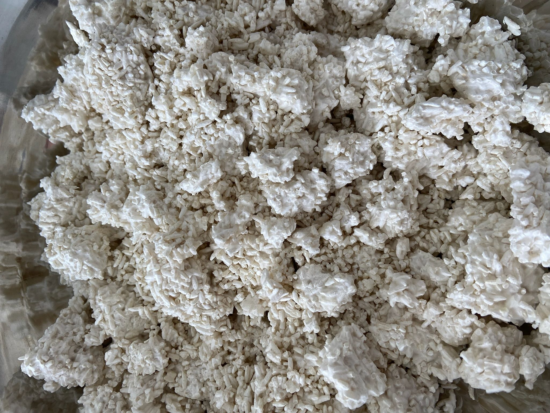
“Koji is the fungus that is used to define the flavor of many of the basic ingredients of Japanese cuisine, such as soy sauce, miso, or rice vinegar,” Elias begins. “To work, koji spores are mixed with a steamed base ingredient and left to act, transforming the starch into sugar and releasing a variety of fatty acids and amino acids ideal for the production of sake or soy sauce, for example.”
But in coffee fermentation, koji spores act differently. “Instead of producing alcohol, carbon dioxide, or organic acids, koji has the ability to transmit its substrate in a different way to the yeasts or bacteria used in the usual coffee fermentations,” Elias explains. “Depending on the variables used in each fermentation, the koji transforms the sugar starch, making the most of the sugars naturally present in each bean, (which makes) Koji-based fermentation a unique type of process.”
Unlike classic coffee fermentation processes, koji fermentation doesn’t start with coffee beans, but with the koji fungus and rice.
How It Works
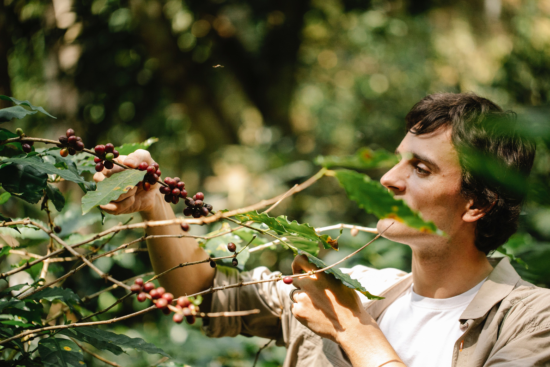
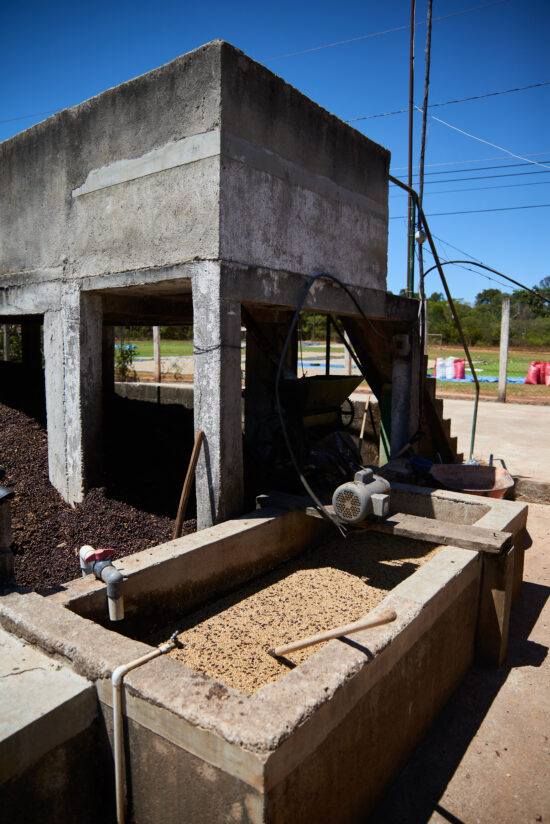
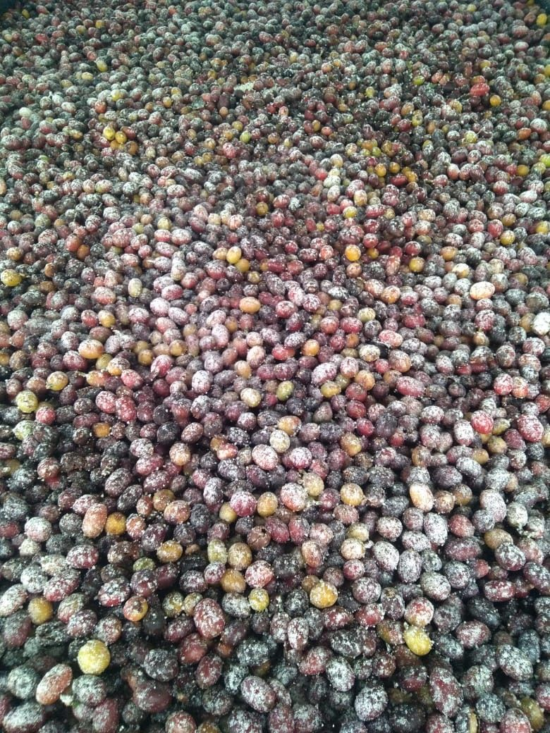
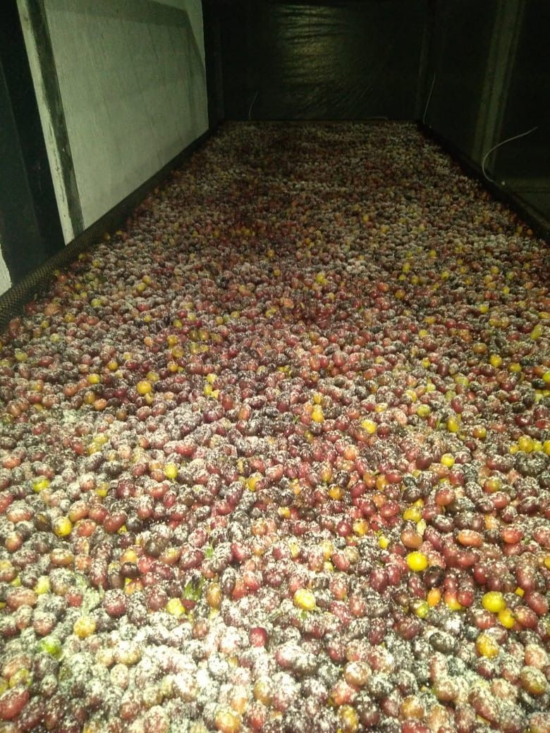
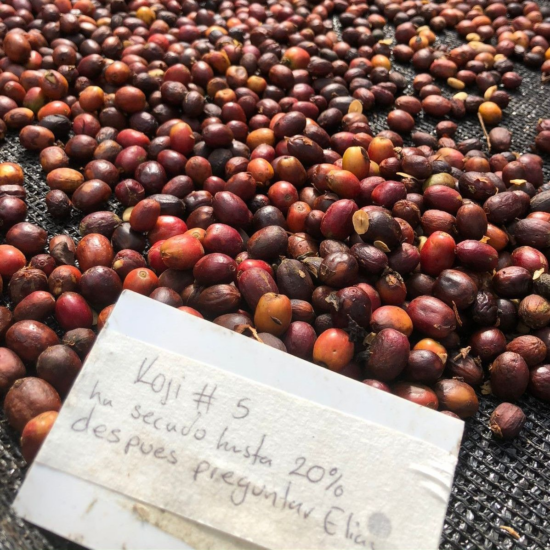
“The process begins by harvesting the koji mushroom in rice, which is crushed to generate a powder,” Elias shares. “Only at this point (does it begin) a process similar to a normal coffee fermentation, where the mature coffee harvests are collected, floated, and separated; then the coffee beans (are poured) into plastic containers that do not exceed 5 cm in height, ensuring that the coffee is uniform. In this way, we provide air to the fruits, because this is an aerobic fermentation. At this moment, the koji spores are poured evenly over the cherries. It should be noted, however, that (it) will take at least 24 to 72 hours for the koji to develop on the fruit and work its magic. Subsequently, the coffee with the spores of the fungus is dried in silos to avoid the decomposition of the coffee cherries … the drying process should be slow and gradual, (and) the temperature should not exceed 34ºC.”
A Sweet Finish
Such a unique fermentation results in a coffee that typically will have more body, more sweetness, and a long aftertaste. “In short,” Elias concludes, “the fermentation of coffee with koji spores is able to bring out sugars in the coffee that are impossible to achieve in conventional fermentation, which helps to give the coffee its extreme sweetness and pleasant aftertaste.”
ABOUT THE AUTHOR
Tanya Nanetti (she/her) is a specialty-coffee barista, a traveler, and a dreamer. When she’s not behind the coffee machine (or visiting some hidden corner of the world), she’s busy writing for Coffee Insurrection, a website about specialty coffee that she’s creating along with her boyfriend.
The post Understanding the Process: Koji Fermentation appeared first on Barista Magazine Online.