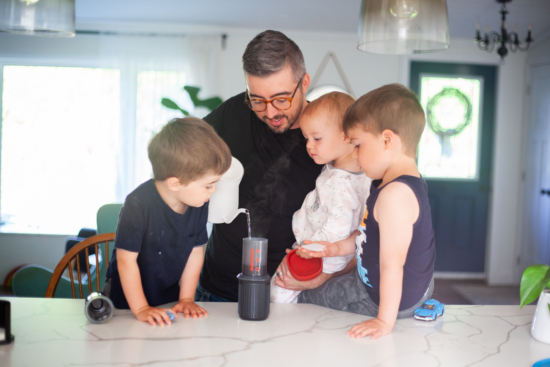

This is the absolute fastest way to make French press iced coffee. Just forget about cold brew concentrate – with this Quick French Press Iced Coffee Recipe you can have your iced coffee ready in 5 – 6 minutes. Who doesn’t like the French press?! It’s...
Sample Roasting
Sample Roasting
Sample Roasting
Sample Roasting
Sample Roasting
Sample Roasting
I Tested Keurig K Compact – Here’s Everything You Need To Know
The most affordable Keurig coffee maker is available exclusively at Walmart and comes at a sweet price of only $59.00. In this article, you’ll find out how good it really is, and also find additional information like how to clean it, or do you need a water...
Here’s How to Change Keurig 2.0 Water Filter Easily
Not sure how to change Keurig 2.0 water filter? Here are step-by-step instructions that will help you do it quickly and easily. Keurig water filter should be changed every 2 months or 60 tank refills. The water filter is located inside the water tank, on the valve at...
The coffee rose for assessing Anaerobic coffee
I just came across this really neat tool to assess anaerobic coffees. I haven't used it for cupping yet. I'm not sure I will like it either because the idea of lowering the score of the coffee just because it tastes has some thyme flavors. At the same time I...
Three US Coffee Championship Events Are Heading To Rancho Cucamonga
This article is from the coffee website Sprudge at http://sprudge.com. This is the RSS feed version. The 2024 US Barista Championship, Brewers Cup, and Cup Tasters will take place March 15-17 at Klatch Coffee Roasters in Rancho Cucamonga, California.
The Origin Story of Turtle Island Coffee in Vancouver, B.C.
A new Indigenous-owned coffee company based in Vancouver, British Columbia, called Turtle Island Coffee has launched with the goal of exposing more people to high quality specialty coffee and Indigenous...
Get Ready for The Barista League’s 2024 Season
The Barista League has announced 12 competitions across four continents. BY J. MARIE CARLANBARISTA MAGAZINE ONLINE Photos courtesy of The Barista League When The Barista…
Get Ready for The Barista League’s 2024 Season
The Barista League has announced 12 competitions across four continents. BY J. MARIE CARLANBARISTA MAGAZINE ONLINE Photos courtesy of The Barista League When The Barista…
Get Ready for The Barista League’s 2024 Season
The Barista League has announced 12 competitions across four continents. BY J. MARIE CARLANBARISTA MAGAZINE ONLINE Photos courtesy of The Barista League When The Barista League announces new events, it’s worth paying attention! This year, the schedule will be...
Weekly Coffee News: EUDR and Africa + More Celebrity Coffee
Welcome to DCN’s Weekly Coffee News. Keep up with all the latest coffee industry stories and career opportunities by subscribing to DCN’s newsletter. Tell our editors about your news here. Report: Small-Scale Farmers in...
Do Higher Coffee Prices Mean More Money For Farmers? A Story From Sumatra Shows It’s Complicated
This article is from the coffee website Sprudge at http://sprudge.com. This is the RSS feed version. Since coffee costs more now than ever, do those coffee prices impact the amount of money earned by coffee farmers?
Coffee News Recap, 2 Feb: Applications open for Australia’s Richest Barista 2024, De’Longhi reports 4.6% revenue increase after La Marzocco move & other stories
Every Friday, Perfect Daily Grind rounds up the top coffee industry news from the previous week. Here are this week’s coffee news stories. The word of the week is: expansion. Mon, 29 Jan AeroPress launches limited-edition Clear Pink brewer. The coffee brewer is made...
Watch The 8 Best Coffee Videos Vying For Sprudgie Awards
This article is from the coffee website Sprudge at http://sprudge.com. This is the RSS feed version. The best coffee videos from 2023 featuring Cafe Imports, Aramse, Nguyen Coffee Supply, Wildly, Mirror Coffee Roasters, Alto Stories, Quek Shio, and Cafe Retiro.
Robusta is great and has untapped potential
I live in the US and my typical choice of coffee is lightly roasted Ethiopian pour overs. I generally love acidity and fruit flavors in my coffee. My experience with Robusta has often been poor. Very dark, roasty and maybe chocolatey. I participated in the Hoffman...
Design Details: Brewing Reinvented at ULA Café in Melbourne
Welcome to Design Details, an ongoing editorial feature in Daily Coffee News focused on individual examples of coffee shop architecture, interior design, packaging design or branding. If you are a coffee...
Robert Downey Jr.’s New “Happy Coffee” Is Really Depressing
This article is from the coffee website Sprudge at http://sprudge.com. This is the RSS feed version. Robert Downey Jr. and Craig Dubitsky team up for Happy Coffee.
Out Now: The February + March 2024 Issue of Barista Magazine!
In our new issue we feature Lisa Lawson from Glasgow, Scotland, take a look at the newest grinders, explore spring drink inspiration, see how more women are getting involved in coffee tech, and much more! BY SARAH ALLENBARISTA MAGAZINE We’re stoked to announce the...
The coffee industry’s biggest competition: The story of the World Barista Championship
Every year, the global coffee industry gears up for one of its most exciting and groundbreaking competitions: the World Barista Championship. For more than two decades, the WBC has been one of the biggest catalysts for change and innovation in specialty coffee, and...
The 2023 Specialty Coffee Transaction Guide Has Landed
The 2023 edition of the Specialty Coffee Transaction Guide (SCTG) guide went live today, providing actors throughout the coffee chain a data-driven tool for green coffee price discovery. The full...
Espro great until I needed replacement filter ☹️
I've had an Espro P7 for nearly four years after seeing glowing praise on this sub (to which I later contributed). Before I bought the P7 I looked at the replacement parts available and they seemed like a solid company in that they sold e.g. replacement filters...
New Bill Requires More Kona In Your Kona Coffee
This article is from the coffee website Sprudge at http://sprudge.com. This is the RSS feed version. Currently a coffee only need to be 10% Kona to be labeled as such.
What’s the best and worst part about owning and running a coffee shop?
I'm not interested in getting into it myself, as I have no experience in the service industry, no real appetite for risk and no desire to run a business in general. But sometimes I think about it and I wonder what's the most enjoyable thing about it and...
minimum dose size?
I use the Hario switch to brew my coffee and am trying to reduce my caffeine consumption. Hence I would like to brew smaller cups of coffee. I am currently using 10g of coffee with 160g of water. (1:16 Ratio) I am wondering if there is a minimum amount of coffee...
[CAFE OWNERS] Background before starting a shop?
I’ve worked in coffee for 6 yrs as a barista and shift supervisor and have passion for it. I’ve decided that I want to open my own place in the future and so I’ve been doing the research to make a business plan. Lately, however, I’ve begun to realize just how many...
Sample Roasting

Photo courtesy of Dear Coffee Buyer by Ryan Brown
Since starting Prodigal, I’ve been thinking a lot about sample roasting. Sample roasting is arguably more important to final product quality than production roasting is, so I have been remiss in not discussing sample roasting more in the past.
What is sample roasting?
Sample roasting involves roasting small quantities of coffee, usually as little as 50g up to 200g, but most commonly 100g, to test and choose which lots of green coffee to buy. Sample roasting is also sometimes used to “profile” a coffee before production roasting, but the utility of such “profiling” is dubious. The word profiling can mean various things, but here it refers to the practice of attempting to learn how to roast a new coffee on a small machine, with the intention of transferring that knowledge to a larger machine. Unfortunately, it is difficult to transfer more than general insights (how much relative power does a coffee require to roast, approximately how does it behave around first crack, what roast color tastes good, etc.) from a small machine to a larger one. Profiling in this way can give one a “ballpark idea” of how to approach a coffee, but cannot, with our current technology and understanding, tell one precisely how to roast a coffee in a larger machine.
Types of sample roasters
Historically, most sample roasters were small drum roasters with open-faced drums, such as in the photo above. While such dinosaurs often churn out surprisingly delicious coffee, they make consistent, predictable results nearly impossible. For a deep dive into why these machines offer poor consistency, and how to modify them for better results, please see my post HERE
In recent years, a plethora of +/-500g drum roasters have hit the market that offer more controlled and consistent, if not always as delicious, sample roasts. Most such machines come from China, have similar features, and none stand out as particularly special. The positive aspects of these machines include fully modulating control over gas, drum RPM, and airflow, and easy connection to software such as Cropster or Artisan. However, some of these machines roast with too much conduction, most have slow bean probes in frankly stupid locations, and some have the reliability of an Edsel. If you don’t know what an Edsel is, consider yourself fortunate.
If you are going to buy one of these small drum roasters, I recommend getting one of the cheaper ones, because they are all similar, with nearly identical designs, and usually require the user to replace and move the BT probe, possibly the gas-pressure gauge, and often a few other small features.
More recently, air roasters such as the Ikawa, Kaffelogic, and Roest have hit the market. The potential roast quality out of air roasters is generally superior to that of drum roasters, since air roasters transfer little to no heat by conduction, but instead use convection, which makes it easier to develop coffee and avoid roasty (not a real word) flavors. Until recently, I was frustrated by the control and repeatability offered by most of these machines, although all have the ability to produce delicious coffee at least some of the time.
What I use
Prior to 2022, my preferred sample roaster was a 500g drum roaster. Such machines offer good data quality down to 100g batches, and offer probably the most insight into how a coffee may behave in a production roaster. Roast quality was “pretty good” but consistent and predictable. I’d rather roast at a quality level of 8/10 consistently than have erratic, and occasionally better, sample roasts, because one needs consistency to give each green sample a fair trial.
More recently, at Prodigal I began using the Roest. For full disclosure, I did not pay for the machine. You don’t have to trust me, but no amount of free stuff could make me use anything but the best possible machine at Prodigal, or could compel me to write a blog post about a product. I needed a great machine to get the most out of my coffee, and for years I’ve been begging manufacturers to build exactly what Roest has built.
My relationship with Roest was rocky at first, as I had a disagreement with someone at the company about roasting data. Because we had such different perspectives, I invited some of the Roest folks as guests at my roasting seminar in Boston last year. They took notes, asked questions, shared their experience designing machines with the class, and — wonderfully — embraced the importance of an effective warmup and between-batch protocol. They were excited, because they recognized an effective BBP was not only necessary for good consistency (yes, even in an air roaster), but also essential for successful automation and replication. I was excited, because a manufacturer finally engaged and cared about the importance of a quality warmup and BBP :). Further discussions led to the addition of an inlet-temperature probe, because using an inlet-temperature recipe is the most effective way to manage an air roaster consistently (more on that in a future post).
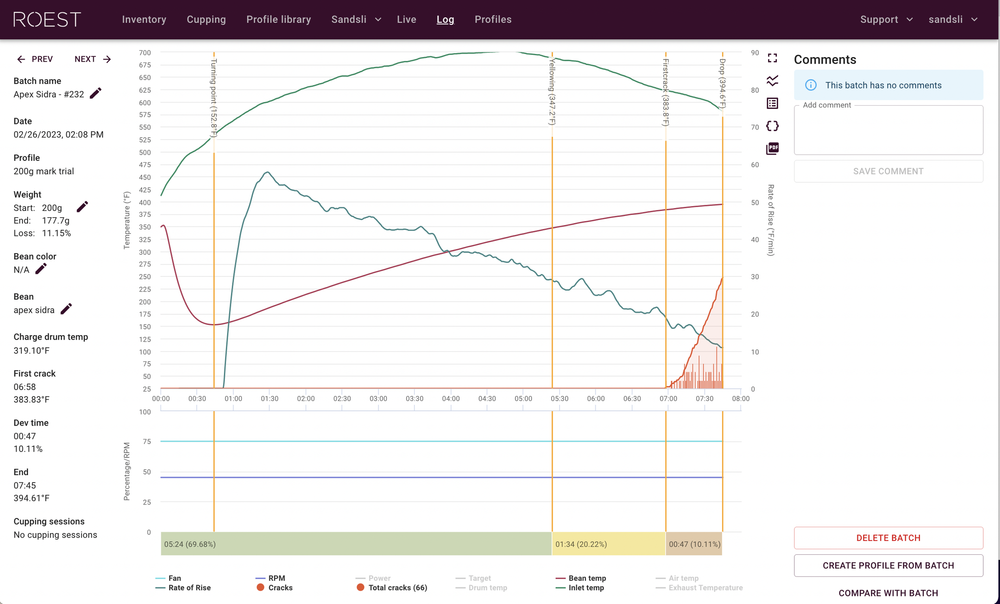
A roast using an inlet-temperature profile (please ignore the “yellowing” note)
Last year, Roest added the ability to create customized warmup and BBP profiles, and now the machine automatically triggers the BBP upon dropping a batch. I cannot say how happy that makes me as a roaster, and also the only person yelling about the importance of an effective BBP for years. The last piece of the puzzle happened this month, as Roest now offers the option to create inlet-temperature profiles based on bean-temperature set points instead of time. Such as system makes consistent, predictable, high-quality roasting possible in a way it had never been before.
I’m grateful to Roest for the machine, but more grateful they care about details, consistency, and continual improvements. Choosing a sample roaster is finally a no-brainer for me.
NB: Readers may notice some similarities between the Roest and the Decent espresso machine. I’m fond of both machines for similar reasons: each is a seamless marriage of user-friendly, clever software and hardware, both companies listen to feedback and rapidly improve and update their software and hardware, and they offer unparalleled control and real-time information while roasting and making espresso, respectively. Most importantly, each offers better coffee, more consistently, than any other machine in its category.
View fullsize 
View fullsize 
View fullsize 
Roest screenshots: 1) An inlet-temperature profile 2)Profile log 3)Roast comparison
Portland Classes
Please join Samo Smrke and me for our masterclasses in Portland.
You can find tickets and details about my roasting masterclass HERE.
Tickets and details of Samo’s “Improving coffee with science” class can be found HERE
Prodigal Update
Prodigal is on hold for another month or two, while we finalize our permits and the installation of our IMF roaster . We may release a small amount of extremely delicious coffee in the next couple of weeks, as we have some stunning green that we want to roast while it is still incredibly fresh. We will update our mailing list and Instagram followers as soon as we know when we will get back to a regular roasting schedule.
Prodigal Coffee at SCA Expo
I’m pleased to announce you will be able to taste two smashing Prodigal coffees at SCA Expo, our washed Colombian “Finca La Indonesia” sidra and washed Colombian “Francy Castillo” geisha. I will roast both coffees on the ROEST, the machine I consider hands-down the best sample roaster.
You can taste Prodigal’s coffee brewed in the new NextLevel Pulsar by the fine folks of NextLevel (they will share Sivetz Roasters’ booth) and also at the ROEST booth. I will spend time brewing the coffees at the two booths, and I’ll post my schedule on Instagram on the day of the event so you know where to find me.
My intention is to not only showcase what the ROEST and Pulsar can do, but to make sure these are the two most memorable coffees you taste at Expo!
You can, of course, also taste Prodigal coffees at my Roasting Masterclass on Saturday.
Thanks to Apex Coffee Imports for sourcing two of the cleanest, prettiest, most floral coffees I have tasted in recent memory.
I look forward to seeing you in Portland!