



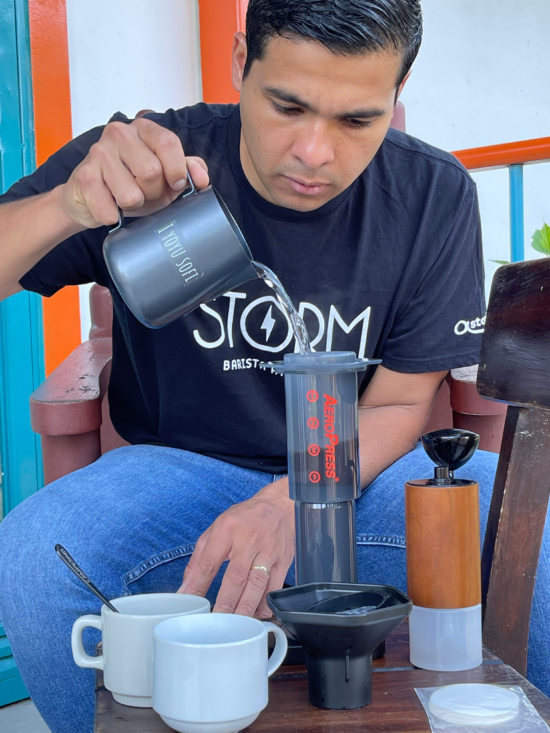
This is the absolute fastest way to make French press iced coffee. Just forget about cold brew concentrate – with this Quick French Press Iced Coffee Recipe you can have your iced coffee ready in 5 – 6 minutes. Who doesn’t like the French press?! It’s...
Does GMO coffee exist?
Does GMO coffee exist?
Does GMO coffee exist?
Does GMO coffee exist?
Does GMO coffee exist?
Does GMO coffee exist?
I Tested Keurig K Compact – Here’s Everything You Need To Know
The most affordable Keurig coffee maker is available exclusively at Walmart and comes at a sweet price of only $59.00. In this article, you’ll find out how good it really is, and also find additional information like how to clean it, or do you need a water...
Here’s How to Change Keurig 2.0 Water Filter Easily
Not sure how to change Keurig 2.0 water filter? Here are step-by-step instructions that will help you do it quickly and easily. Keurig water filter should be changed every 2 months or 60 tank refills. The water filter is located inside the water tank, on the valve at...
The coffee rose for assessing Anaerobic coffee
I just came across this really neat tool to assess anaerobic coffees. I haven't used it for cupping yet. I'm not sure I will like it either because the idea of lowering the score of the coffee just because it tastes has some thyme flavors. At the same time I...
Three US Coffee Championship Events Are Heading To Rancho Cucamonga
This article is from the coffee website Sprudge at http://sprudge.com. This is the RSS feed version. The 2024 US Barista Championship, Brewers Cup, and Cup Tasters will take place March 15-17 at Klatch Coffee Roasters in Rancho Cucamonga, California.
The Origin Story of Turtle Island Coffee in Vancouver, B.C.
A new Indigenous-owned coffee company based in Vancouver, British Columbia, called Turtle Island Coffee has launched with the goal of exposing more people to high quality specialty coffee and Indigenous...
Get Ready for The Barista League’s 2024 Season
The Barista League has announced 12 competitions across four continents. BY J. MARIE CARLANBARISTA MAGAZINE ONLINE Photos courtesy of The Barista League When The Barista…
Get Ready for The Barista League’s 2024 Season
The Barista League has announced 12 competitions across four continents. BY J. MARIE CARLANBARISTA MAGAZINE ONLINE Photos courtesy of The Barista League When The Barista…
Get Ready for The Barista League’s 2024 Season
The Barista League has announced 12 competitions across four continents. BY J. MARIE CARLANBARISTA MAGAZINE ONLINE Photos courtesy of The Barista League When The Barista League announces new events, it’s worth paying attention! This year, the schedule will be...
Weekly Coffee News: EUDR and Africa + More Celebrity Coffee
Welcome to DCN’s Weekly Coffee News. Keep up with all the latest coffee industry stories and career opportunities by subscribing to DCN’s newsletter. Tell our editors about your news here. Report: Small-Scale Farmers in...
Do Higher Coffee Prices Mean More Money For Farmers? A Story From Sumatra Shows It’s Complicated
This article is from the coffee website Sprudge at http://sprudge.com. This is the RSS feed version. Since coffee costs more now than ever, do those coffee prices impact the amount of money earned by coffee farmers?
Coffee News Recap, 2 Feb: Applications open for Australia’s Richest Barista 2024, De’Longhi reports 4.6% revenue increase after La Marzocco move & other stories
Every Friday, Perfect Daily Grind rounds up the top coffee industry news from the previous week. Here are this week’s coffee news stories. The word of the week is: expansion. Mon, 29 Jan AeroPress launches limited-edition Clear Pink brewer. The coffee brewer is made...
Watch The 8 Best Coffee Videos Vying For Sprudgie Awards
This article is from the coffee website Sprudge at http://sprudge.com. This is the RSS feed version. The best coffee videos from 2023 featuring Cafe Imports, Aramse, Nguyen Coffee Supply, Wildly, Mirror Coffee Roasters, Alto Stories, Quek Shio, and Cafe Retiro.
Robusta is great and has untapped potential
I live in the US and my typical choice of coffee is lightly roasted Ethiopian pour overs. I generally love acidity and fruit flavors in my coffee. My experience with Robusta has often been poor. Very dark, roasty and maybe chocolatey. I participated in the Hoffman...
Design Details: Brewing Reinvented at ULA Café in Melbourne
Welcome to Design Details, an ongoing editorial feature in Daily Coffee News focused on individual examples of coffee shop architecture, interior design, packaging design or branding. If you are a coffee...
Robert Downey Jr.’s New “Happy Coffee” Is Really Depressing
This article is from the coffee website Sprudge at http://sprudge.com. This is the RSS feed version. Robert Downey Jr. and Craig Dubitsky team up for Happy Coffee.
Out Now: The February + March 2024 Issue of Barista Magazine!
In our new issue we feature Lisa Lawson from Glasgow, Scotland, take a look at the newest grinders, explore spring drink inspiration, see how more women are getting involved in coffee tech, and much more! BY SARAH ALLENBARISTA MAGAZINE We’re stoked to announce the...
The coffee industry’s biggest competition: The story of the World Barista Championship
Every year, the global coffee industry gears up for one of its most exciting and groundbreaking competitions: the World Barista Championship. For more than two decades, the WBC has been one of the biggest catalysts for change and innovation in specialty coffee, and...
The 2023 Specialty Coffee Transaction Guide Has Landed
The 2023 edition of the Specialty Coffee Transaction Guide (SCTG) guide went live today, providing actors throughout the coffee chain a data-driven tool for green coffee price discovery. The full...
Espro great until I needed replacement filter ☹️
I've had an Espro P7 for nearly four years after seeing glowing praise on this sub (to which I later contributed). Before I bought the P7 I looked at the replacement parts available and they seemed like a solid company in that they sold e.g. replacement filters...
New Bill Requires More Kona In Your Kona Coffee
This article is from the coffee website Sprudge at http://sprudge.com. This is the RSS feed version. Currently a coffee only need to be 10% Kona to be labeled as such.
What’s the best and worst part about owning and running a coffee shop?
I'm not interested in getting into it myself, as I have no experience in the service industry, no real appetite for risk and no desire to run a business in general. But sometimes I think about it and I wonder what's the most enjoyable thing about it and...
minimum dose size?
I use the Hario switch to brew my coffee and am trying to reduce my caffeine consumption. Hence I would like to brew smaller cups of coffee. I am currently using 10g of coffee with 160g of water. (1:16 Ratio) I am wondering if there is a minimum amount of coffee...
[CAFE OWNERS] Background before starting a shop?
I’ve worked in coffee for 6 yrs as a barista and shift supervisor and have passion for it. I’ve decided that I want to open my own place in the future and so I’ve been doing the research to make a business plan. Lately, however, I’ve begun to realize just how many...
Does GMO coffee exist?
Coffee is one of the world’s biggest cash crops, with coffee production supporting an estimated 125 million people along the Bean Belt. According to the International Coffee Organisation, some 167.2 million 60kg bags of green coffee will be produced in 2022/23.
Today, there are around 120 identified species of coffee, which means there is an almost endless number of different varieties – especially when we consider wild varieties which grow naturally. Hybrid varieties, which are cultivated by researchers and agronomists to improve both yield and quality, are also becoming more common.
And while these hybrid varieties aren’t technically genetically modified, their existence still leads to a pertinent question: can coffee be genetically modified? And if so, what are the advantages?
To find out, I spoke with the CEO of RD2 Vision, Dr. Christophe Montagnon, and Divisional Head of the Coffee Board at India’s Central Coffee Research Institute, Dr. Manoj Kumar Mishra. Read on for more of their insight on GMO coffee.
You may also like our article on introducing climate-resilient coffee hybrids in Vietnam.

How does genetic modification work?
For centuries, humans have been selectively breeding plants and animals in order to produce higher yields and create more resilient and stronger livestock. This technique involves choosing plant or animal parents which have particular desirable characteristics. For coffee, this can include better resistance to pests and diseases, as well as more climate-resilient traits.
When breeding together two parents with desirable traits, it’s more likely that the offspring will also inherit them. In turn, this changes the plant’s or animal’s characteristics over time to be better suited for cultivation and breeding for human consumption.
Genetic modification, however, involves altering a plant’s or animal’s genetic material (or DNA) in a way which cannot occur naturally. Essentially, this means genetic modification can only take place in a controlled environment, such as a laboratory.
According to the World Health Organisation, the only genetically modified organisms (GMO) which are currently available have all been developed from plants. The most commonly grown GMOs are corn, soybeans, cotton, and canola plants, based on information from the US Food and Drug Administration.
There are a number of benefits to growing GMOs – for example, they can have higher yields and quality, as well as improving resistance to pests and diseases. Farmers can also grow GMO crops to reduce the use of their agricultural inputs, particularly fertilisers.
However, there are also several risks associated with cultivating and producing GMO crops. Arguably, the biggest concern is reducing the genetic diversity of a plant or animal, which can lead to a number of problems such as a higher susceptibility to a certain type of pest or disease.
“The exact risks associated with producing and consuming GMO crops are not yet fully known,” Manoj tells me – ultimately, more scientific research is needed to fully understand both the benefits and risks of GMOs.

Is it possible to genetically modify coffee?
Although a number of crops are genetically modified, is it possible to do the same with coffee?
According to the National Coffee Association, there is currently no commercially-available genetically modified coffee. However, the NCA also emphasises that certain ingredients which can be added to coffee products (such as flavourings and additives) could be classified as GMO – especially if they are corn or soy-based.
While there isn’t any genetically modified coffee available on the market, Christophe tells me that in 2005, he managed a project organised by the French agricultural research institute CIRAD. The project was developed to cultivate genetically modified robusta in French Guiana – an overseas department of France on the northeast coast of South America.
“In our research, we studied robusta’s resistance to the coffee leaf miner,” Christophe says. By the end of the trial, he says 70% of the genetically modified coffee plants were completely resistant to the coffee leaf miner – a moth that lays eggs on the leaves of coffee plants, which ultimately kills them.
While the trial produced promising results, the genetically modified robusta plants were never disseminated to local coffee farmers.
“Our findings were not for commercial use – just to increase our scientific knowledge of coffee production,” Christophe explains.

What about hybrid varieties?
It’s important for us to distinguish between GMOs and hybrid coffee varieties.
Although hybrid varieties are created through human intervention, they are developed using natural techniques, as Christophe explains.
“Hand pollination can be carried out by humans, but it could also occur naturally through mating or natural recombination,” he says.
Hybrid varieties are often created to combine different desirable characteristics in the same plant, such as high yield and cup quality.
One example is F1 (or first generation) hybrid varieties, which first became available to coffee farmers in 2010.
According to World Coffee Research, the first-ever F1 hybrid to be propagated by seed was Starmaya – a high-yielding arabica variety which is resistant to coffee leaf rust.
Through seed propagation, as opposed to using biotechnologies such as tissue cloning, agronomists were able to cultivate Starmaya much more efficiently than other F1 hybrid varieties. However, the process of developing any type of hybrid variety is lengthy and can be costly, too.
Other research
Alongside hybrid varieties, Manoj tells me there is also plenty of research underway on genome sequencing for both arabica and robusta plants.
“[Through genome sequencing], we are able to understand the agronomic traits of arabica and robusta, such as quality and tolerance to pests, diseases, and climatic conditions,” he says. “This research will also essentially expedite other studies in the coming years [as the data is more readily available].
“It also means that more desirable characteristics of certain varieties could be more easily introduced to other varieties through conventional breeding methods or molecular gene editing technology,” he adds.
Moreover, further genetic research on some wild coffee species, such as Coffea racemosa and Coffee zanguebariae, could provide agronomists with more information on how coffee plants can naturally become more climate resilient over time.
However, research from Royal Botanic Gardens, Kew in the UK has found that while these species have some desirable characteristics – including high cup quality when grown using specific farming techniques – yields are generally very low. Ultimately, more research is needed at this point in time.

The challenges associated with GMOs
There’s no denying that there are benefits to cultivating and growing genetically modified crops, particularly for smallholder producers who may be struggling with the effects of climate change. If more research was to be conducted into growing GMO coffee, they could pose a number of benefits.
However, there are also a number of challenges related to developing GMO coffee, as Manoj explains.
“The technology used to develop genetically modified coffee is extremely difficult to navigate,” he says. “The process also consists of several critical steps which would all need to be optimised and improved so that we could understand more about the expression and integration of a coffee’s genes.
“Moreover, there are very few laboratories in the world which have the experience and expertise to develop genetically modified coffee,” he adds. “Other barriers include strict governmental regulation of producing GMOs, as well as negative public perception about genetically modified products.”
Although some organisations and scientific institutions claim that GMO foods are safe to consume, other research indicates that they can be harmful to the environment and human health.
For instance, in the 2013 Genetically modified foods: safety, risks and public concerns—a review research paper, it was found that consuming GMO foods could increase the chances of an allergic reaction. This is because GMOs contain foreign genes, so the risk that they are contaminated with allergens from other foods can increase.
These concerns have meant that some coffee brands have even labelled their products as certified organic or indicated that they are a part of the Non-GMO project. This is a certification organisation which verifies that a product’s ingredients have not been genetically modified.

It’s evident that we’re a long way off from growing genetically modified coffee, particularly for commercial purposes. However, it is something we could see more of in the future – especially as climate change becomes more of a threat to sustainable coffee production.
But whether consumers would be open to drinking GMO coffee is another question. Ultimately, considering it is still more a concept than something in practice, the only thing we know for now is that more research is necessary.
Enjoyed this? Then read our article on how rootstock grafting can make coffee plants more resilient.
Perfect Daily Grind
Want to read more articles like this? Sign up for our newsletter!
The post Does GMO coffee exist? appeared first on Perfect Daily Grind.