

This is the absolute fastest way to make French press iced coffee. Just forget about cold brew concentrate – with this Quick French Press Iced Coffee Recipe you can have your iced coffee ready in 5 – 6 minutes. Who doesn’t like the French press?! It’s...
The 2:1 Ratio
The 2:1 Ratio
The 2:1 Ratio
The 2:1 Ratio
The 2:1 Ratio
The 2:1 Ratio
I Tested Keurig K Compact – Here’s Everything You Need To Know
The most affordable Keurig coffee maker is available exclusively at Walmart and comes at a sweet price of only $59.00. In this article, you’ll find out how good it really is, and also find additional information like how to clean it, or do you need a water...
Here’s How to Change Keurig 2.0 Water Filter Easily
Not sure how to change Keurig 2.0 water filter? Here are step-by-step instructions that will help you do it quickly and easily. Keurig water filter should be changed every 2 months or 60 tank refills. The water filter is located inside the water tank, on the valve at...
The coffee rose for assessing Anaerobic coffee
I just came across this really neat tool to assess anaerobic coffees. I haven't used it for cupping yet. I'm not sure I will like it either because the idea of lowering the score of the coffee just because it tastes has some thyme flavors. At the same time I...
Three US Coffee Championship Events Are Heading To Rancho Cucamonga
This article is from the coffee website Sprudge at http://sprudge.com. This is the RSS feed version. The 2024 US Barista Championship, Brewers Cup, and Cup Tasters will take place March 15-17 at Klatch Coffee Roasters in Rancho Cucamonga, California.
The Origin Story of Turtle Island Coffee in Vancouver, B.C.
A new Indigenous-owned coffee company based in Vancouver, British Columbia, called Turtle Island Coffee has launched with the goal of exposing more people to high quality specialty coffee and Indigenous...
Get Ready for The Barista League’s 2024 Season
The Barista League has announced 12 competitions across four continents. BY J. MARIE CARLANBARISTA MAGAZINE ONLINE Photos courtesy of The Barista League When The Barista…
Get Ready for The Barista League’s 2024 Season
The Barista League has announced 12 competitions across four continents. BY J. MARIE CARLANBARISTA MAGAZINE ONLINE Photos courtesy of The Barista League When The Barista…
Get Ready for The Barista League’s 2024 Season
The Barista League has announced 12 competitions across four continents. BY J. MARIE CARLANBARISTA MAGAZINE ONLINE Photos courtesy of The Barista League When The Barista League announces new events, it’s worth paying attention! This year, the schedule will be...
Weekly Coffee News: EUDR and Africa + More Celebrity Coffee
Welcome to DCN’s Weekly Coffee News. Keep up with all the latest coffee industry stories and career opportunities by subscribing to DCN’s newsletter. Tell our editors about your news here. Report: Small-Scale Farmers in...
Do Higher Coffee Prices Mean More Money For Farmers? A Story From Sumatra Shows It’s Complicated
This article is from the coffee website Sprudge at http://sprudge.com. This is the RSS feed version. Since coffee costs more now than ever, do those coffee prices impact the amount of money earned by coffee farmers?
Coffee News Recap, 2 Feb: Applications open for Australia’s Richest Barista 2024, De’Longhi reports 4.6% revenue increase after La Marzocco move & other stories
Every Friday, Perfect Daily Grind rounds up the top coffee industry news from the previous week. Here are this week’s coffee news stories. The word of the week is: expansion. Mon, 29 Jan AeroPress launches limited-edition Clear Pink brewer. The coffee brewer is made...
Watch The 8 Best Coffee Videos Vying For Sprudgie Awards
This article is from the coffee website Sprudge at http://sprudge.com. This is the RSS feed version. The best coffee videos from 2023 featuring Cafe Imports, Aramse, Nguyen Coffee Supply, Wildly, Mirror Coffee Roasters, Alto Stories, Quek Shio, and Cafe Retiro.
Robusta is great and has untapped potential
I live in the US and my typical choice of coffee is lightly roasted Ethiopian pour overs. I generally love acidity and fruit flavors in my coffee. My experience with Robusta has often been poor. Very dark, roasty and maybe chocolatey. I participated in the Hoffman...
Design Details: Brewing Reinvented at ULA Café in Melbourne
Welcome to Design Details, an ongoing editorial feature in Daily Coffee News focused on individual examples of coffee shop architecture, interior design, packaging design or branding. If you are a coffee...
Robert Downey Jr.’s New “Happy Coffee” Is Really Depressing
This article is from the coffee website Sprudge at http://sprudge.com. This is the RSS feed version. Robert Downey Jr. and Craig Dubitsky team up for Happy Coffee.
Out Now: The February + March 2024 Issue of Barista Magazine!
In our new issue we feature Lisa Lawson from Glasgow, Scotland, take a look at the newest grinders, explore spring drink inspiration, see how more women are getting involved in coffee tech, and much more! BY SARAH ALLENBARISTA MAGAZINE We’re stoked to announce the...
The coffee industry’s biggest competition: The story of the World Barista Championship
Every year, the global coffee industry gears up for one of its most exciting and groundbreaking competitions: the World Barista Championship. For more than two decades, the WBC has been one of the biggest catalysts for change and innovation in specialty coffee, and...
The 2023 Specialty Coffee Transaction Guide Has Landed
The 2023 edition of the Specialty Coffee Transaction Guide (SCTG) guide went live today, providing actors throughout the coffee chain a data-driven tool for green coffee price discovery. The full...
Espro great until I needed replacement filter ☹️
I've had an Espro P7 for nearly four years after seeing glowing praise on this sub (to which I later contributed). Before I bought the P7 I looked at the replacement parts available and they seemed like a solid company in that they sold e.g. replacement filters...
New Bill Requires More Kona In Your Kona Coffee
This article is from the coffee website Sprudge at http://sprudge.com. This is the RSS feed version. Currently a coffee only need to be 10% Kona to be labeled as such.
What’s the best and worst part about owning and running a coffee shop?
I'm not interested in getting into it myself, as I have no experience in the service industry, no real appetite for risk and no desire to run a business in general. But sometimes I think about it and I wonder what's the most enjoyable thing about it and...
minimum dose size?
I use the Hario switch to brew my coffee and am trying to reduce my caffeine consumption. Hence I would like to brew smaller cups of coffee. I am currently using 10g of coffee with 160g of water. (1:16 Ratio) I am wondering if there is a minimum amount of coffee...
[CAFE OWNERS] Background before starting a shop?
I’ve worked in coffee for 6 yrs as a barista and shift supervisor and have passion for it. I’ve decided that I want to open my own place in the future and so I’ve been doing the research to make a business plan. Lately, however, I’ve begun to realize just how many...
The 2:1 Ratio
If third wavers are good at anything, it’s following trends and adopting new dogmas. If I didn’t know any better, I would say that most young baristas are glued to Instagram all day, just waiting to see what trend they should unquestioningly follow next. Call me crazy.
One of the stickier trends in the past couple of years has been the near-religious adherence, at least in the US, to the 2:1 espresso-brewing ratio. I’d like to discuss what an espresso-brewing ratio (EBR) is, why it’s relevant, and why it’s a little silly for so many cafes to latch on to this suspiciously harmonious ratio.
What is an Espresso-Brewing Ratio?
Simply put, it’s the ratio of an espresso’s beverage weight to the weight of the dry grounds used to make the shot. For example, if a barista pulls a 36g shot from 18g of grounds , the ratio would be 2:1.
Why EBR is relevant
I suspect most baristas do not realize this: if you have exact targets for extraction % and TDS, there is only one EBR that can produce a shot that achieves both targets. For example, let’s say you desire a 20% extraction and 10% TDS. Using a slightly simplified calculation, the only EBR that can produce a 20% extraction/10% TDS shot is a 2:1 ratio.
For example, with a 20g dose and 40g shot:
10% TDS = 4g of coffee solids (10% x 40g shot = 4g)
4g of coffee solids extracted from a 20g dose = 20% extraction
A 2:1 EBR can yield a spectrum of extraction/TDS combinations; for example 8% TDS/16% extraction or 9%TDS/18%ext. But no other EBR can produce any of the combinations mentioned above.
What if you want 10% TDS and a 22% extraction? That requires an EBR of 2.2:1.* And so on. (Note that your EBR also happens to approximate the ratio of your chosen extraction% to TDS.)
*These calculations are slightly simplified to help illustrate the concept; please don’t get hung up on the imprecision.
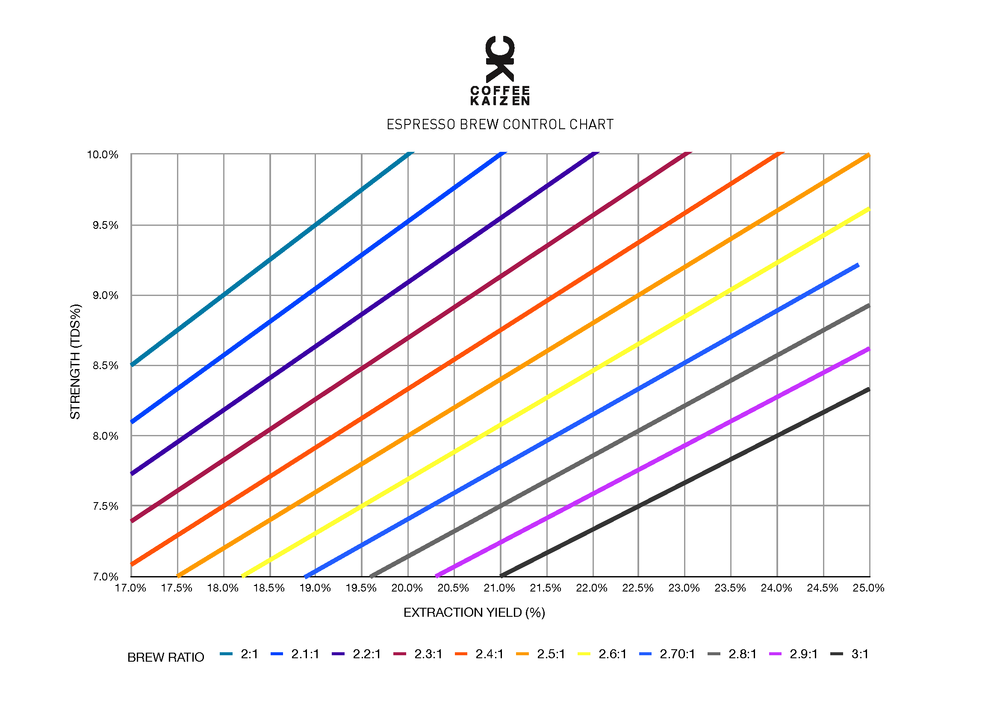
Sam Sgambellone of Coffee Kaizen generously shared this chart showing the possible extraction%/TDS combinations possible with various EBRs. Thanks, Sam!
Here’s a printable link to Sam’s chart:
Why it’s a mistake for most cafes to get hung up on the 2:1 ratio
I’d like to offer three assertions:
1. A cafe should choose its EBR, ground dose, and shot weight as a system, based on the style and size of drinks it serves.
2. The “best” extraction % using a given set of brewing parameters (e.g. shot time, ratio, temperature, etc.) is usually the highest that one can achieve. Various combinations of grinder and espresso machine may call for different EBRs and extraction levels to yield the best-tasting shots. (i.e. better machinery can yield higher extractions at lower EBRs.)
3. Most cafes using a 2:1 ratio serve underextracted espresso and should explore higher EBRs to make their espresso riper, less sour, and less sharp.
Based on these assertions, the “one size fits all” approach to EBR seems a little unreasonable.
How to choose an appropriate dose and EBR
Let’s look at three espresso shots:
The first shot is destined to be drowned in a 16oz (450ml) latte in the US. For the coffee flavor to not disappear in the milk, the barista may want to cram as much coffee solids as reasonably possible in the drink. The barista may choose a large, 20g dose and a higher EBR, of let’s say 2.5:1. At a 21% extraction and 8.4% TDS, the baristas has added 4.2g of coffee solids to the latte.
The second shot is pulled by a barista in Rome, and is destined for a 5oz (150ml) cappuccino. The Italian barista will likely use 7g of coffee and a 2:1 ratio to yield a 19% extraction and 9.5% TDS. He will have added 1.3g of coffee solids to the drink. (It’s surprising but true: large lattes in the US and cappuccini in Italy are typically of similar strength. Italian capps likely often seem stronger due to frequent use of darker roasts and lots of robusta.)
The third shot is pulled by a barista in Melbourne as a “short black.” To provide high extraction and good flavor clarity using a light-roast geisha (washed, of course), the barista may choose a high ratio such as 3:1 and modest TDS. For example, most Australian baristas “split shots” (pull two separate shots per portafilter) and may use 20g of grounds and a 3:1 ratio to yield two short blacks, each a 30g shot from a 10g dose. Such a shot may have an extraction of 22% and TDS of 7.3% to optimize flavor and clarity at the expense of strength and body.
The best extraction is the highest extraction, within reason
I can’t tell you what the “best” extraction level is for your espresso shots. But I will tell you that you’ve probably never had an overextracted espresso. What?? Yes, it’s true. Sure, you’ve had shots that were channeled, bitter, or had overextracted flavors. But when’s the last time you accidentally pulled, say, a 26% extraction, without doing something extreme, like using a 10:1 ratio? The “overextracted” shots you’ve pulled were channeled, or perhaps your burrs were dull or misaligned, but your shots were not overextracted in the mathematical sense. If you’re pulling 21% shots using an EK and you think they’re overextracted, check your burrs and your puck prep prior to lowering your extraction target.
NB: Your shots may not look channeled, but when you finally pull shots on a Decent Espresso Machine next year and get to see the volatility in the flow-rate graphs of your shots (the volatility indicates channeling), you’ll see that all shots channel. The DE1+ tells me that my shots channel, and so do those of several friends who have won the WBC. We’ve just never had the data and feedback needed to recognize and fix the problem. Maybe one day when we all have roller mills, Decent Espresso Machines, better puck prep, and perfectly-developed coffee, we’ll be able to routinely pull non-channeled, 30% extractions and decide our shots really are overextracted. Until then, you’re generally better off doing whatever increases your extractions. (As an aside, John Buckman of Decent is now possibly the world’s best barista at avoiding channels, as he has pulled more shots on the DE1+ than anyone else, and the machine’s feedback has made John’s learning curve nearly vertical. He also now knows more than anyone about shot dynamics and the effects of different puck-prep methods.)
Baristas should usually aim for the highest extraction possible when using standard EBRs (very high EBRs will always channel extensively, and in such cases maximizing extraction may not be wise.) If you taste symptoms of overextraction, work on your puck prep and ensure you’re using adequate preinfusion (very few baristas do).
Most cafes attempting to use a 2:1 ratio are underextracting their espresso.
The most important reason most baristas should question the 2:1 ratio is that they may be serving underextracted espresso. By “underextracted” I simply mean the coffee would taste better if the extractions were higher.
Simply put, if you’ve got a setup such as a Mazzer grinder (low extractions) and a La Marzocco Linea (no proper preinfusion, no pressure decline), and you use a 2:1 ratio, you’re likely underextracting. Using an espresso machine that offers slow, low-flow preinfusion, or a well-programmed pressure-profile machine, and/or using a higher-extracting grinder, such as a Mythos or a Peak, can each significantly boost extraction quality and quantity. Unfortunately, equipment selection is another area where baristas and shop owners do more trend following than analytical thinking, but more on that some other time.
How to test whether your coffee would taste better at a higher extraction
This is not a foolproof test, but it’s worth trying, and takes only a few minutes. Let’s say you typically pull shots with 2:1 EBRs using 18g in/36g out in 30 seconds. Try this instead: set your grinder one small notch coarser. Purge a couple of doses from the grinder. Pull a 3:1 ratio shot (18g in/ 54g out) in 30—35 seconds. You’ve now likely increased extraction by more than one percentage point. Assuming the shot did not channel more than usual, taste the coffee and evaluate whether you prefer the flavor to that of your 2:1 ratio shots. If you were underextracting at 2:1, you’ll likely find the 3:1 shot is juicier, less sharp, and less sour.
The test is imperfect, primarily because we’ve changed the flow rate, but almost all baristas who have done this test with me preferred the flavor of the 3:1 shot over the 2:1 shot.
The Upshot
When choosing an EBR, consider factors such as your preferred extraction level, TDS, shot weight, beverage size, the quality of your equipment, and the purpose of the shots (will it be served black? how much milk does it have to balance?). One factor to not consider is what everyone else is doing. Sure, if an expert such as James H. or Matt P. makes a recommendation, give it serious consideration and a fair trial. But if you make brewing and equipment choices based on what everyone else does, you’ll likely make average coffee (by definition, if you just follow the herd, your results will be average) and you may do something silly like spend ten years serving 1:1 ristrettos (remember those days?)
Thanks for reading. Please share your thoughts.